


Processors
CPU and SoC news from Intel, AMD, Apple Silicon, ARM, and Qualcomm - launches, benchmarks, and architecture updates from TweakTown.
Stay Updated
Follow TweakTown for breaking tech news, reviews, and daily updates.


As an Amazon Associate, we earn from qualifying purchases. TweakTown may also earn commissions from other affiliate partners at no extra cost to you.
User receives Intel Core i9-10900K in sealed AMD Ryzen 7 9800X3D box from Amazon in CPU swap scam
A Facebook post from a hardware community group just caught my attention, and it's a frustrating one. Apparently, this buyer, Crayola Johnson, ordered AMD's Ryzen 7 9800X3D from Amazon and received an Intel Core i9-10900K instead. The box arrived sealed with no visible signs of tampering, meaning whoever made the swap did so before the product even reached the customer's hands.

This is far from an isolated incident. We've covered multiple CPU switching cases on TweakTown over the past couple of years. Earlier in 2025, a reviewer from Hardware Busters ordered a 9800X3D from Amazon Germany and found an AMD FX-4100 inside a sealed box. Before that, fake 7800X3D units with empty PCBs and counterfeit heatspreaders were circulating, and we also reported on a Ryzen 9 9950X3D that arrived with a 3D-printed base and no actual CPU under the IHS.
The 10900K is a 2020 Intel chip on the LGA1200 socket, so it is completely incompatible with any AM5 motherboard the victim would have bought to pair with the 9800X3D. The value gap is also significant: the 10900K trades for well under $100 on the used market today, while the 9800X3D retails around $479. Clearly, the buyer would have been less than pleased with this CPU swap.
Intel is bringing Raptor Lake Next to gaming laptops with DDR4 support and up to 24 cores
Last week, reports suggested that Intel will reintroduce its Core "Raptor Lake" client microarchitecture as "Raptor Lake Next" under a new Core (non-Ultra) naming scheme. Now, a new leak suggests that the platform will not be exclusive to desktop but will also extend to mobile.

According to leaker Jaykihn on X, Intel is also preparing HX mobile variants of Raptor Lake Next, bringing the refreshed architecture to high-performance gaming laptops with up to 24 CPU cores.
The lineup will be HX-only, meaning Intel currently has no plans for lower-power H, P, or U series variants. The flagship will be a Core 9 chip with an 8P+16E core configuration. This matches the layout of the existing Core i9-14900HX and delivers 24 cores and 32 threads with HyperThreading. Below that, two Core 7 variants are planned: one with an 8P+12E configuration for 20 cores, and another with a 6P+8E arrangement for 14 cores, a configuration that previously appeared in Core 5 territory.
Another AMD AM5 CPU has reportedly swelled and died, this time a Ryzen 9 9900X less than a year old
Another AMD AM5 processor has reportedly failed with a visible physical deformation, this time a Ryzen 9 9900X. Reddit user TheImmigrantEngineer posted about the incident, describing how their PC suddenly stopped working, with a Code 00 error displayed, and the red CPU debug LED visible on an MSI MAG X870E Tomahawk WiFi motherboard.

After removing the cooler and CPU to investigate, the owner found a small physical bump on the underside of the processor near the center of the contact pad area. The integrated heat spreader showed no visible damage, and the thermal paste spread appeared normal. The damage was between the silicon and the substrate beneath it, invisible from the outside until the chip was removed.
The system was less than a year old and was running a Corsair RM1000X power supply and a 240mm DeepCool AIO cooler. The PSU was tested in another system without issues, ruling it out as the cause. No manual overclocking or voltage tuning was applied, though Precision Boost Overdrive was enabled in the BIOS, meaning the system was not running a fully stock configuration. The BIOS in use was from early 2026 and was flashed sometime between late January and early February, which rules out any early AM5 launch BIOS issues as a contributing factor.
AMD Zen 6 will target a 7 GHz boost clock for Ryzen CPUs, according to insider
AMD's next-gen Zen 6 architecture just got a lot more interesting. Moore's Law is Dead (MLID) has shared details from an alleged AMD insider who claims to have seen internal documentation with some lofty goals. Apparently, AMD's Zen 6 is targeting boost clocks of at least 7 GHz on at least one product.

Critically, this wasn't an aspirational goal from months ago, as the source confirms AMD was still targeting those speeds in Q1 2026. This suggests that the number is being taken seriously as we head into the final stages of silicon production. It is worth noting this covers at least one Zen 6 product, so the 7 GHz figure likely applies to the highest-end SKU, possibly an X-suffix flagship or a future X3D variant at launch.
This jump in clock speed would be historically significant. Previous leaks have already pointed toward AMD aiming for 7 GHz with Zen 6, and the process node making that possible is TSMC's N2P (2nm). Zen 6 CCDs skip the 3nm node entirely, jumping from Zen 5's 4nm to 2nm, which represents the same kind of multi-node leap AMD used when going from Zen 3 to Zen 4.
Intel Core 3 304 'Wildcat Lake' CPU appears on PassMark, matches the MacBook Neo
More samples of Intel's Core 300 "Wildcat Lake" CPUs are starting to appear on PassMark. Interestingly, the Intel Core 3 304 just pulled off something nobody expected from the bottom of the Wildcat Lake stack. Recently, a third PassMark entry was submitted for the entry-level Wildcat Lake chip, and it shows it matching the Apple A18 Pro in single-threaded performance, both landing at exactly 3,982 points.

That's a notable jump, especially for a chip that sips just 15W of power. The previous best for the Core 3 304 was 3,632 single-thread points, so this third sample pushed it meaningfully higher. With only three samples in the database, the chip's current average sits at 3,676 points, putting it around 8% behind the A18 Pro overall, but the individual peak score tells a different story.
Multi-threaded performance is also competitive, with the 304 sitting at a CPU Mark of around 11,543 versus the A18 Pro's 11,804, which is remarkably close given that the Core 3 304 has one fewer core. On average, the Core 3 304 is about 8% slower than the Apple A18 Pro in single-threaded performance, while being only 2.2% slower in multi-threaded results.
Apple will be working with Intel to design and build its chips in the USA, confirms President Donald Trump
U.S. President Donald Trump dropped a late-night Truth Social post on June 18, confirming that Apple has agreed to work with Intel to design and build its chips in America.

There's just one small detail he left out: Intel didn't know the announcement was coming.
AMD confirms Ryzen Threadripper TR6 'Mustang Peak' with Zen 6 cores, 2nm process, and PCIe 6.0 support
AMD has officially confirmed its next-generation Ryzen Threadripper family, codenamed "Mustang Peak." The upcoming lineup will move to a new TR6 platform, bringing Zen 6 cores built on TSMC's 2nm process and PCIe 6.0 support. The confirmation comes from AMD's own documentation, spotted by leaker IntaLatX64, which lists "TR6 Mustang Peak" as a Threadripper Pro CPU under the Family 1Ah Model A8h series.

AMD has not released specifics such as SKUs, core counts, clock speeds, cache sizes, TDPs, chipsets, or a release window. What the documentation does confirm is DDR5 memory support and PCIe Gen 6, the latter doubling per-lane bandwidth compared to the PCIe 5.0 lanes on the current TR5 platform.
The current Ryzen Threadripper 9000 series, codenamed Shimada Peak, is based on 3nm Zen 5 architecture and tops out at 96 cores and 192 threads with a 350W TDP and up to 128 PCIe 5.0 lanes. TR5 has served two generations now, covering both the Threadripper 7000 and 9000 families, making TR6 the first platform change since the 7000 series launched.
Intel's 18A-P process node is now in risk production, will power next-gen Xeon 'Diamond Rapids' processors
Intel used the 2026 VLSI Symposium in Honolulu this week to confirm that its 18A-P process node has officially entered risk production, hitting the timeline it promised customers and partners last year. That is a meaningful checkpoint. Risk production means the node is transitioning from R&D to early-stage manufacturing, with data indicating it will meet customer requirements before full qualification.

The numbers Intel put on the board are solid for what is a node refresh rather than a full generational leap. It looks like 18A-P delivers 9% higher performance at the same power draw compared to standard 18A, or 18% lower power consumption at equivalent performance. Thermal resistance improves by 20-40%, and via resistance drops by 10-30%.
In terms of features, Intel also unveiled Power Boost, a new dual-contact, low-resistance transistor option that increases drive current and gives designers more frequency headroom. As we previously covered, these figures were already circulating before VLSI, and Intel has now officially confirmed them all.
AMD's Zen 6 Olympic Ridge reportedly drops the iGPU entirely in exchange for a dedicated NPU
AMD's next-generation Ryzen desktop processors are shaping up to make a notable trade-off. According to a leak from X user Gotou_3rd, corroborated by Wccftech, the upcoming Zen 6-based lineup codenamed Olympic Ridge will integrate a dedicated NPU into the processor's I/O die while removing the integrated GPU entirely.

Since the Ryzen 7000 series launched on AM5, AMD has included a basic two-compute-unit Radeon GPU on its desktop processors. It is not a gaming solution by any measure, but it serves a real purpose for office deployments and, more practically, for diagnostics when a discrete GPU fails or a system boots to a black screen. Removing it means builders will need a working discrete card to troubleshoot video-related issues.
The silicon space freed up by removing the iGPU is being reallocated to an NPU, making Olympic Ridge the first standard non-APU AMD desktop CPU to feature dedicated AI acceleration hardware. AMD already offers NPUs in its AM5 desktop APUs and the Ryzen AI Halo mini PC, but those are based on mobile-style APU silicon.
Intel x86 processors with GeForce RTX graphics are reportedly coming in 2028
At Computex 2026, the biggest announcement, from a consumer technology perspective, was RTX Spark. NVIDIA's all-in-one SoC that pairs its Arm-based Grace CPU technology (developed in partnership with MediaTek) with RTX Blackwell graphics. With the RTX Spark launch on track for later this year, these chips are set to power a range of premium laptops and mini PCs, with a focus on powerful local AI, creative workloads, and ray-traced PC gaming.

With its Arm CPU cores, RTX Spark devices will ship with an overhauled and optimized version of Windows on Arm, which NVIDIA has been working with Microsoft closely on. However, RTX Spark isn't the only all-in-one chip with NVIDIA graphics that's set to compete with the likes of Ryzen AI, as Intel is reportedly building a new line of x86 CPUs with integrated GeForce RTX graphics. Although details are scarce, both NVIDIA CEO Jensen Huang and Intel CEO Lip-Bu Tan have confirmed this collaboration last year.
According to a new report over at VideoCardz, citing a former tech site editor, Erdi Özüağ, who has apparently seen Intel's current roadmap, Intel's first x86 processors with integrated RTX graphics are on track for a Q1 2028 release. And with that a potential announcement and reveal could take place at CES 2028.
AMD is due to release a pair of CPUs based on an architecture released over 7 years ago, but are they interesting?
AMD is gearing up to release a pair of Ryzen 3000 series 'Picasso' CPUs. But they aren't based on the Zen 4 or even Zen 3 or 2 architectures, but the Zen+ architecture that was released back in 2019. The two chips come with Radeon Vega graphics and are being targeted at entry-level laptops with the FP5 socket. As they are FP5 chips, they don't have retail pricing, and are clearly being released to support OEMs. It's safe to say they will be far cheaper than AMD's Ryzen AI 400 chips.

The Ryzen 3 3100U is a very basic chip by modern standards. It's a dual-core chip without hyperthreading. It has a boost clock of 3.2GHz, 4MB of L3 cache, and a default 15W TDP. It has an 8-core Vega 8 GPU which was actually highly regarded back in its day. Suffice to say this is a chip that won't win any benchmark races in 2026 and it won't be suitable for anything outside of basic Windows tasks. But, it's a well-established architecture that will be easy for OEMs to incorporate into 'new' designs.
The second chip is more powerful. The Ryzen 5 3501U is a 4-core, 8-thread design with a boost clock of up to 3.7GHz. It has the same Vega 8 graphics as the 3100U, but its higher thread count makes it more suitable for multitasking.
AMD marketing chief brags on X about dominating Amazon's best seller CPU list, top 15 slots solely include Ryzen CPUs
AMD's senior marketing director Saša Marinković went on X to brag about the company's domination on Amazon's best-sellers CPU list, sharing a screenshot showing the top 15 spots (at the time of publishing) were held entirely by Ryzen CPUs.

AMD has perpetually grown its domination on Amazon's best sellers page over the past several years. AMD began to take off in this "metric" during the Zen 2 era where its CPUs started to take over the top five spots in Amazon's best sellers list on an almost regular basis. More recently, the top 10 spots have regularly been held by various Ryzen CPUs - new and old.
Currently, the lead is even greater with the top 16 places on Amazon's best sellers list consisting of Zen 3, Zen 4, and Zen 5 parts. The only exception is the inclusion of a Thermal Grizzly AM5 contact frame that is taking up one of the slots. The Ryzen 7 9800X3D unsurprisingly sits in first place, but contrarily, the Ryzen 5 5500 takes up the second spot, showing sky-high consumer demand for previous generation budget CPUs amidst the outgoing memory shortage. Critically, the Ryzen 5 5500 can use DDR4 memory, which is cheaper than DDR5 and more readily available. Positions three through ten are held by the Ryzen 5 9600X, Ryzen 7 7800X3D, Ryzen 7 5800XT, Ryzen 9 9950X3D, Ryzen 9 5900XT, Ryzen 5 7600X, Ryzen 5 5600, and Ryzen 7 7700X. The new Ryzen 7 9850X3D sits in 16th despite being a faster version of the 9800X3D for an extra $40.
Intel is prepping to launch 'Raptor Lake Next' CPUs and bring back DDR4 memory support
According to a new report over at Tom's Hardware, Intel is looking toward bringing back the LGA 1700 platform in 2027 with a 'Raptor Lake Next' desktop CPU lineup that's all about supporting older hardware and breathing more life into DDR4-based systems. It's a move that makes sense, especially in light of AMD's recent Ryzen 7 5800X3D revival and continued AM4 support, which is also a DDR4-based platform.

For those who need a refresher, Intel's 'Raptor Lake' architecture debuted with the 13th-Gen Intel Core series of processors. And on that note, the Intel Core i9 14900K, which is based on 'Raptor Lake,' is still widely considered one of the company's best pure gaming CPUs.
And in the context of PC gaming, the rumored 'Raptor Lake Next' CPU lineup begins to make sense in light of rising DDR5 memory prices and gamers on a budget looking for a viable upgrade that still lets them make use of their DDR4 memory and storage. According to the report, this refresh will also see new LGA 1700 motherboards hit the market, with at least two vendors telling Tom's Hardware that it's about to increase production of AMD AM4, Intel LGA 1700, and DDR4 motherboards.
AMD reversed a warranty rejection for a swollen Ryzen 9 7950X3D after Hardware Unboxed called it out publicly
AMD has agreed to replace a damaged Ryzen 9 7950X3D after initially rejecting the warranty claim. The change in decisions came only after Hardware Unboxed publicly called out the company on X. The case was first reported by Reddit user VINCENT199411, who said their system shut down with a loud pop while idle on April 28, 2026.

The user added that the PC would no longer boot after the incident, and inspection revealed visible swelling on the back of the CPU's substrate. The system used a GIGABYTE X670E AORUS MASTER motherboard, Kingston Fury Beast DDR5-6000 memory, and a be quiet! Dark Power 13 1000W Titanium power supply. EXPO was enabled, but no manual CPU overclocking or SoC voltage tuning had been applied.
Both the motherboard and power supply were cleared of faults. GIGABYTE reflashed a corrupted BIOS, adjusted the CPU socket pin alignment, and the board passed over 64 hours of stress testing. Be quiet! ran the PSU through 12V, load, dynamic, and burn-in testing with no issues found. With both components cleared, the CPU was the only remaining candidate.
Amazon's Graviton5 processor will go head-to-head with Intel and AMD in the cloud
Amazon Web Services (AWS) is one of the largest cloud companies in the world, and for several years it has been developing and deploying AWS Graviton processors for web applications, analytics, databases, machine learning (ML) inference, gaming, video encoding, and more. The latest in-house AWS processor, designed and built in collaboration with Annapurna Labs on TSMC's 3nm process, the AWS Graviton5, is here.

The chiplet design features an impressive 192 Arm V3 cores, a 5X increase in L3 Cache, a 33% lower inter-core latency, 420 GB/s die-to-die bandwidth, PCIe Gen6 and DDR5-8800 memory support with a bandwidth of 800+ GB/sec. AWS notes that compared to Graviton4-based instances, the new Graviton5 offers up to 35% faster performance for AI inference, making it an ideal chip for the current agentic era. And when it comes to memory, it delivers the "fastest memory of any processor instances in the cloud."
Naturally, this means that Amazon's new M9g instances powered by AWS Graviton5 are outperforming previous-gen AWS instances powered by Intel Xeon "Cascade Lake" and AMD EPYC "Genoa" processors. And with that, AWS confirms that Meta is one of its largest customers, and is deploying Graviton5 "at scale" with tens of millions of CPU cores supporting the company's agentic AI push.
AMD says its next-gen EPYC 'Venice' processor is over 3X faster than NVIDIA Vera
At Computex 2026, NVIDIA unveiled Vera, its new CPU purpose-built for large-scale AI deployments and agentic systems. With its 88-core Arm-based design, it's a general-purpose data center-focused CPU powered by Arm v9.2-A 'Olympus' cores. Compared to the previous generation's Grace processor, NVIDIA claims a 1.5X increase in IPC and around 50% faster performance than existing x86 solutions.

Although a lot of the focus in the past has been placed on GPU performance, with the rise of AI factories and agents, the CPU is quickly becoming a critical component - and it's an area or market that's still relatively new for NVIDIA. Not so for AMD, which has been delivering its data center-focused EPYC processors for years now. When it comes to AI, AMD has released new performance benchmarks showing that its EPYC lineup, including the next-gen 256-core EPYC 'Venice' processor, outperforms NVIDIA Vera and Intel Xeon.
However, it's worth noting that these benchmarks are based on a single data-center rack with a 100 kW power budget, and Vera's performance is an estimate based on currently available data. "Data centers are provisioned in racks, and racks are bounded by a fixed power and thermal budget, finite floor space, software-compatibility requirements, and operational readiness," AMD explains. Adding that its numbers are based on a full workload set rather than a "single favorable benchmark."
Leaked Intel Nova Lake-S image confirms new LGA-1954 socket and a notch placement that kills backward compatibility
The first image of an Intel Nova Lake-S desktop CPU has leaked online, giving us our earliest look at the processor that will sit in Intel's new LGA-1954 socket. Posted on X by user PoTAToOOOO, the image shows the pad side of the chip, labeled simply as "NovaLake-S LGA1954."

The photo confirms several details about the new platform. The notch placement on Nova Lake-S has moved from the left side, where it sits on current Arrow Lake-S processors, to the right side, making the chip physically incompatible with older sockets. The overall package size also differs, so there is no question of backward compatibility. The leaker notes that the front side of the package looks almost identical to Intel's Alder Lake 12th Gen processors in terms of general layout, though the socket has moved from LGA-1700 to LGA-1954.
The pad layout on the backside shows at least 35 capacitors, compared to 36 on the current Core Ultra 9 285K, with more contact pads distributed along the edges than on current-generation offerings. The chip will support both single-lever and dual-lever ILM socket configurations.
Intel brings back Raptor Lake with the Core 7 230H and Core 5 205H CPUs with disabled integrated graphics
Intel has quietly added two new processors to its lineup, and they come with a twist. The Core 7 230H and Core 5 205H are both Raptor Lake chips officially released in 2026, carrying the Core 200-series naming that would normally suggest Arrow Lake. The missing "Ultra" tag gives it away, though. These are 13th/14th-gen Raptor Lake parts in disguise, and Intel has confirmed it directly in its own spec listings.

The Core 7 230H is a 10-core part built around a 6P+4E configuration with 16 threads. It boosts up to 5.2 GHz, packs 24 MB of L3 cache, and operates within a 45W base and 115W max turbo power envelope. That puts it squarely in the same territory as the Core 7 240H in terms of clocks and cache, though there is one notable difference. The 230H appears to top out at DDR5-5200 speeds, whereas the 240H can handle up to DDR5-6400. Whether that is a deliberate downgrade or a spec page error is not officially known.
The Core 5 205H is an 8-core chip with a 4P+4E layout, 12 threads, a 4.8 GHz boost clock, and 12 MB of L3 cache. It shares the same 45-115W TDP range as its bigger sibling. Both chips have one notable limitation: integrated graphics are fully disabled on both processors. That makes them purely for systems paired with a discrete GPU.
AMD hits an all-time high x86 CPU market share record, now holding a third of the server market
AMD has hit an all-time high in overall x86 CPU market share, reaching 32.6% in Q1 2026, according to Mercury Research. A year ago, that number was 27.1%, meaning AMD has gained nearly 6 percentage points in a single year. Intel still leads with 67.4%, but that figure is down from 72.9% a year ago and down sequentially from 68.6% last quarter.

The server market is where AMD's momentum is most visible. The company now holds 33.2% of x86 server CPU shipments, up from 27.2% a year ago and 30% last quarter, meaning AMD now controls roughly a third of a market Intel has long dominated. Overall server CPU unit shipments were more than 10% higher year-on-year, driven almost entirely by AI data center demand. Intel's server shipments remained relatively flat both sequentially and year-on-year. A separate Mercury Research report previously showed that AMD's EPYC CPUs accounted for 46.2% of total server CPU spending in Q1 2026.
AMD's unit shipments increased by nearly 17% year over year, while Intel's declined by more than 10%, a gap that explains the five-and-a-half-point swing in overall share over the same period. Last year, Intel decided to allocate more production capacity to server chips, which had a knock-on effect on other product lines, and AMD benefited. Across the entire x86 processor market, AMD also secured close to a third of all shipments. Worth noting is that this figure includes console SoCs, where AMD has a near-monopoly. Stripping those out, AMD's share of the broader CPU market stood at 30%, still up from 29.3% in the previous quarter and 24.4% year on year.
Intel's upcoming LGA1954 socket makes an appearance with a dual retention mechanism
More and more information is starting to appear regarding Intel's upcoming Nova Lake-S desktop platform. During Computex week, tech YouTuber Laurent's Choice (LC Tech Leaks) posted a photo on X showing what appears to be Intel's upcoming LGA1954 socket, captured somewhere in Taipei. No board vendor was named, and it's likely an early engineering sample floating around with a motherboard manufacturer, but the image is real enough to confirm some key details.

The most immediately noticeable thing from the photo is the retention mechanism. Intel is going with a 2L-ILM design, short for two-lever independent loading mechanism. That's a notable departure from the single-lever setup on LGA1851. The dual-lever design distributes the clamping load more evenly across the processor, which is intended to keep the IHS flat and improve contact with your cooler, directly translating into better thermal performance.
It's essentially Intel addressing "bendgate" at the socket level rather than leaving it to users with aftermarket retention kits. Not every Nova Lake CPU in the lineup will require it, so the 2L-ILM is expected to be optional depending on the board.
 OLED buyer becomes victim of Amazon scam, receives broken 240Hz OLED screen instead of 540Hz OLED they initially ordered
 Google taps MediaTek to build its next Triggerfish TPU chip launching in 2027
 Samsung announces world's first UFS 5.0 chip with 10.8 GB/s read and 9.5 GB/s write speeds
 GTA 6 will feature a story chapter system like Red Dead Redemption 2
 AMD confirms Adrenalin 26.6.2 driver fails to launch on Windows 10, recommends rolling back
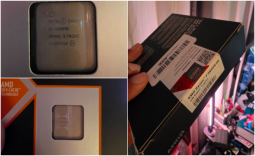 User receives Intel Core i9-10900K in sealed AMD Ryzen 7 9800X3D box from Amazon in CPU swap scam
 GTA 6 'plays best' on PS5, Sony confirms PS5 Pro enhancements
 GTA 6 is a 'singleplayer experience,' GTA Online may be sold separately
 Rockstar confirms GTA 6's price, no physical disc version
 Ausom discounts three electric scooters by up to $100 in new soccer promotion
 Dell XPS 14 (2026) Laptop Review - Premium Quality, Impressive Performance
 Ocypus Sigma F36 BK ARGB Cooling Fan Review: high airflow and unified design in one frame
 PCCooler CPS RZ820 Display Review: a flagship-level CPU air cooler with an LCD screen
 UGREEN FineTrack Mini 2 Air Tracker Tag Review - Long battery life, lesser performance
 Speed Racer (2008) 4K Ultra HD Blu-ray Review: a stunning remaster of the cult classic
 MOAIPLAY ORA PRO G1 850W ATX 3.1 PSU Review: high efficiency and 10-year warranty for $119.99
 Navman MiVue Smart True 4K Surround Dashcam Review - Seeing In All Directions At Once
 IQUNIX Magi96 Pro Aluminum Low Profile Mechanical Keyboard Review - Premium Build, Satisfying Sound
 Asetek Forte S-Series Racing Simulator Bundle Review
 Razer Pro Type Ergo Wireless Split Ergonomic Keyboard Review - Built for Comfort and Support
 Level Up Your PC Gaming with these Fantastic ASUS Prime Day Deals on GPUs, Motherboards, and More
 GIGABYTE Wants to Kickstart Your New Gaming PC or Upgrade with These Limited-Time Deals
 7 Windows settings to change right after installation for better privacy, security, and performance
 I stopped Windows 11 notifications from interrupting me with Do Not Disturb, Focus, and a priority list
 7 ways to transfer data from Android to Windows PC quickly and easily
 I read the Windows Backup app screen carefully, and it does not back up what most people think
 Low Sound Volume on Windows 11? How to fix audio issues and restore normal volume
 8 Critical Warning Signs You Should Never Ignore in Windows 11
 This Windows security feature protects Documents from ransomware, but it is off by default
 Windows 11 already has a voice typing tool, and it is the one most people are not using