
Our Verdict
Pros
- 5G LAN
- Lots of USB ports
- Dual PCIe 5.0 M.2 slots
- Attractive design
Cons
- SSD cooling is a step backward
- Expensive
- No USB4
Should you buy it?
Introduction, Specifications, and Pricing
AMD's X3D CPUs are the best gaming CPUs available, and a system built with a 9000 series X3D chip will provide strong gaming performance for years to come. Pair it with a capable motherboard, and you'll have the foundation of a high-performance gaming PC, plus the bonus of Zen 6 CPU support to extend its life even further.
Today, we're reviewing the GIGABYTE B850 AORUS Elite X3D. It's GIGABYTE's first B850 motherboard to support X3D Turbo Mode 2.0, which aims to squeeze even more performance out of an X3D processor. Turbo Mode 2.0 comes with some lofty performance claims, and I'll cover them later in the review.
Popular Now: DLSS 5 has been modded into Skyrim, and it definitely transforms character facesThe days of B-series motherboards being considered 'budget' are long gone. The B850 AORUS Elite X3D is far from a cheap option thanks to its feature set. It offers strong connectivity, a capable thermal design, and a great aesthetic. It's got a 64MB BIOS ROM, which means it is well prepared to accept future Zen 6 CPUs. That gives users peace of mind for their investment.
| Item | Details |
|---|---|
| Model | GIGABYTE B850 AORUS Elite X3D |
| CPU Socket | AM5 |
| Chipset | AMD B850 |
| CPU Support | AMD 7000, 8000 & 9000 series |
| Memory | 4 x DDR5 DIMM slots, up to 256GB, up to 8200+ MT/s (OC) |
| Expansion slots | 1x PCIe 5.0 x16, 1x PCIe 4.0 x16 (x4) |
| Storage | 4x M.2, 2x SATA |
| Ethernet | 1x Realtek RTL8126 5GbE |
| Wireless & Bluetooth | Realtek RTL8922AE Wi-Fi 7, Bluetooth 5.4 |
| USB | Up to 1x USB 20Gbps, 4x USB 10Gbps 6x USB 5Gbps, 8x USB 2.0 |
| Audio | Realtek ALC1220 |
| Form Factor | ATX |
| MSRP | $289 |
Like all B850 motherboards, the B850 AORUS Elite X3D supports AMD AM5 Ryzen 7000, 8000, and 9000 series CPUs. It supports up to 256GB of memory and includes ease-of-use features such as toolless M.2 heatsinks, a PCIe quick-release mechanism, and a Wi-Fi EZ-plug.
The B850 AORUS Elite X3D is slowly making its way to the market. Its launch price is $289. That's a lot compared with first-generation B850 competitors, which you can find for under $200, including GIGABYTE's own B850 AORUS Elite. However, the upgraded X3D includes faster 5G LAN, an extra M.2 slot, a 64MB BIOS with integrated Wi-Fi driver, and a better VRM.
Packaging, Accessories, and Overview
Packaging and Accessories


Best Deals: GIGABYTE B850 AORUS Elite WIFI7 AM5 ATX Motherboard
Price Trend:
Prices last scanned 19 hours and 31 minutes ago

7 days ago: $202.41 USD30 days ago: $189.45 USD

7 days ago: $209.99 USD
7 days ago: $322.10 CAD30 days ago: $338.86 CAD
7 days ago: $329 CAD
7 days ago: £214.9930 days ago: £205.99

7 days ago: $26930 days ago: $269
7 days ago: $363.42 AUD30 days ago: $353.89 AUD
The AORUS Eagle dominates the B850 AORUS Elite X3D box. I think that's a claw, but it could be a fistful of dollars.

The rear of the box showcases all of the board's key features, including purported X3D Turbo Mode 2.0 benefits, and a look at the well-equipped rear I/O.
Our Latest Socket AM5 Review Coverage
- ASRock X870E Taichi White Review: a premium AM5 motherboard with 10G LAN and WiFi 7
- ASUS ROG Strix X870E-A Gaming WiFI7 Neo Review - A New Enticing Option
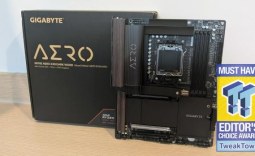
- GIGABYTE X870E Aero X3D Dark Wood Review - A woody goody
- ASUS TUF Gaming X870-Pro WiFi7 W NEO Review - Tuffed up
- ASUS ROG Strix X870E-E Gaming WiFi7 NEO - A Crosshair by any other name

The board comes with a solid set of accessories. It includes setup and installation guides, two SATA cables, M.2 spacer pads, an AORUS case badge, stickers, a front panel header connector, and the Wi-Fi antenna. This antenna features GIGABYTE's Wi-Fi EZ-Plug, which is a single plug-in connector that doesn't require any screwing in.

Frequently Asked Questions
Open a question for an answer from TweakTown's coverage of this review, or ask your own below.
How do I enable and choose between X3D Turbo Mode 2.0's Extreme Gaming Mode and Max Performance Mode in the BIOS?
What VRM configuration and cooling does the board use, and is it adequate for a Ryzen 9 9950X/9950X3D?
What USB ports and speeds are available on the rear I/O and internal headers, and does the 20Gbps Type-C support USB Power Delivery?
What networking and wireless controllers are used (5GbE and Wi‑Fi 7) and what real-world limitations should I expect?
Have a question about this content not listed here? Ask below and TweakBot will answer it.

Motherboard Overview

The B850 AORUS Elite X3D is an ATX offering with a good-looking, nearly all-black design with hints of grey. The silver PCIe slot stands out a bit, but that will be hidden under a graphics card. Two small banks of RGB lighting are included. One is placed alongside the chipset heatsink at the lower right of the board, and the other is the large AORUS logo atop the rear I/O area. RGB enthusiasts are well catered for, with an additional three ARGB headers and a single RGB header for showcase builds.
It offers a solid set of onboard USB headers, including up to four USB 2.0 ports, two 5Gbps ports, and a single Type-C 20Gbps port. This port doesn't support USB PD. It is the fastest on the board. The rear ports max out at 10Gbps.
The board includes an impressive 8 fan headers, 2 thermistor headers, and reset and CMOS clear headers. Perhaps the only notable omission is a debug display. There's no need for power and reset buttons as they are included on the back panel.

A backplate covers the rear of the board. It adds rigidity and helps cool the rear of the VRM subsystem.

Four DIMM slots support DDR5 speeds up to 8200+. That's not an extreme number, but it's more than enough, given AMD recommends memory speeds in the 6000-6400 MT/s range in 1:1 mode for the best balance of speed, latency, and compatibility. Given current RAM pricing, it makes little sense to buy high-speed RAM anyway, let alone 256GB of it! Zen 6 is expected to support CUDIMMs, and higher speeds may be officially supported later.
The picture above shows the front 20Gbps header and the quick-release PCIe button. The BIOS battery is unusually located, but this placement makes it easy to access.

The board offers a single PCIe 5.0 x16 slot. The lower x16 slot is wired to the chipset and supports PCIe 4.0 x4 electrically. It's a good layout that gives large graphics cards room to breathe without impacting an additional expansion card.
The B850 AORUS Elite X3D includes four M.2 slots, two of which support PCIe 5.0, though only one includes an underside thermal pad. The other two slots are connected to the chipset and support PCIe 4.0.
Note that the second, or lowest PCIe 4.0 M.2 (M2D_SB) slot shares bandwidth with the PCIe 4.0 expansion slot. If it's populated, the expansion slot is disabled.
2 SATA ports join the four M.2 slots.

A dedicated heatsink cools the primary M.2 slot. While it works well enough, it lacks surface area compared to a board like the X870E AORUS Elite X3D. Fair enough: the B850 version is cheaper, but it's a clear step backward compared to some of the outstanding GIGABYTE M.2 coolers we've seen in recent years.
A large plate cools the other three slots. If you plan to use all three, adequate case cooling is definitely recommended, as this plate sits directly underneath a heat-dumping graphics card. Leaving your GPU fans at 0% when it's idling can result in high SSD temperatures.

The B850 AORUS Elite X3D features a solid 16+2+2-phase VRM with 60A stages. It's not at the level of a high-end X870E board, but it's perfectly adequate for a mid-range board. AMD Ryzen processors aren't known to be power guzzlers, so it's more than enough to power an overclocked Ryzen 9 9950X with PBO or X3D Turbo Mode 2.0 enabled.
The B850 AORUS Elite X3D's heatsinks have a large surface area and include a heatpipe and 5W/mK thermal pads. It extends to the rear I/O, and the exhaust fan in a typical ATX case will help dissipate VRM heat.

The rear I/O of the B850 AORUS Elite X3D has both positives and negatives. The USB complement includes dual 10Gbps Type-C ports and two additional Type-A ports. Next up are four 5Gbps ports and four USB 2.0 ports. That gives 12 in total. It would be nice to see USB4 at this level, but that's surely a conscious design decision by GIGABYTE, which instead allocated lanes to a second PCIe 5.0 M.2 slot. Adding USB4 and dual PCIe 5.0 slots would require too many lane-sharing compromises.
GIGABYTE chose a Realtek RTL8126 controller for the single 5G LAN port. It's great to see high-speed LAN trickling down to more affordable boards. A Realtek RTL8922AE Wi-Fi 7 controller supports 160MHz connections only. Given the slow uptake of Wi-Fi 7, it remains to be seen if 320MHz support will become a must-have.
Next are the audio ports, which consist of 3.5mm line-in and line-out ports and S/PDIF. A Realtek ALC1220 codec drives these. The ALC4080 family has mostly supplanted this codec, but it still does the job.
There are CMOS clear and BIOS flashback buttons. Several recent GIGABYTE boards feature power and reset buttons on the rear I/O panel rather than on the PCB itself. I think this is a good thing. While the positioning of such buttons makes little difference if the board is used outside a case, placing them at the rear makes them easier to access without opening the case.
An HDMI 2.1 port provides the sole graphics output.
UEFI, X3D Turbo Mode 2 and Test System
UEFI


GIGABYTE's Aorus-themed BIOSes haven't changed much recently, so their layout will remain familiar to anyone who's owned a GIGABYTE board in the past few years. It features an attractive color scheme with easy-to-read fonts. Most options are easy to find.
A common trend among refreshed 800 series boards is the inclusion of a 64MB BIOS ROM. A larger ROM guarantees support for future-generation Zen 6 and maybe even Zen 7 CPUs. It also provides enough space for GIGABYTE to include a Wi-Fi driver, giving instant Wi-Fi access after a Windows installation. As someone who builds a lot of PCs, this negates the sometimes fiddly need to download a Wi-Fi driver from another device and then transfer it via a flash drive to the new PC.
X3D Turbo Mode 2
You can enable the much-hyped X3D Turbo Mode 2.0 feature via the Easy Mode page or the Tweaker page in the Advanced section. Think of it like Precision Boost Overdrive on steroids.
According to GIGABYTE, X3D Turbo Mode 2.0 is an AI-powered performance enhancement designed to extract greater performance from AMD Ryzen X3D processors. It optimizes performance in real time, delivering up to a 25% uplift.
The AI model is trained using data from many X3D systems. It analyzes power management, temperatures, and frequencies, along with dynamic workload sensing, at millisecond intervals.
Two settings are available: Extreme Gaming Mode and Max Performance Mode. As the names suggest, Extreme Gaming Mode optimizes gaming performance, while Max Performance Mode boosts general workflow performance.
When using a 9950X3D, Extreme Gaming Mode disables the X3D cache-less CCD entirely and also turns off multi-threading, resulting in an 8-core/8-thread configuration. Effectively, that's a quasi 9800X3D with SMT turned off.
Max Performance mode can deliver higher boost clocks, but only momentarily. Loading all cores and threads results in Cinebench and Blender results nearly identical to default settings.
Extreme Gaming mode is potentially more exciting. It can deliver genuine improvements depending on the game. But as always, your results will depend on the game and your hardware configuration. Extreme Gaming Mode benefits gamers with powerful graphics cards. In graphically limited scenarios with cheaper GPUs, the benefits will not be apparent.
X3D Turbo Mode 2.0 may not be the ultimate one-click OC solution, but Extreme Gaming Mode is worth tinkering with, especially at lower resolutions and in games known to be CPU-limited.
Test System
- CPU: AMD Ryzen 9 9950X - Buy from Amazon
- GPU: MSI GeForce RTX 4070 Ti Super Ventus 3X - Buy from Amazon
- RAM: G.Skill Trident Z Neo RGB 2x16GB DDR5-6000 CL30 - Buy from Amazon
- Cooler: Cooler Master MasterLiquid PL360 Flux - Buy from Amazon
- OS Storage: Teamgroup T-Force Z540 2TB - Buy from Amazon
- Power Supply: Super Flower Leadex Titanium 850W - Buy from Amazon
- OS: Microsoft Windows 11 Pro - Buy from Amazon
Benchmarks - Rendering and Encoding
Cinebench 2024
Cinebench 2024 is a reliable, widely used benchmark that measures both single- and multi-threaded performance. Note that all our benchmark testing used the latest available Windows updates.

The B850 AORUS Elite X3D performed well, achieving 2,300 in the nT test and 139 in the 1T test.
Blender
A rendering application like Blender is just one of many reasons a user might consider a high-core-count CPU, such as the Ryzen 9 9950X. We use the Whitelands demo file and record how long it takes to render the image.

A result of 429 seconds is another strong result, even if a second or two over a seven-minute test is negligible.
Handbrake
Handbrake is a simple-to-use video encoding and transcoding application. Here, we convert a 4K movie trailer to 1080p. The results below show the average FPS. A higher result indicates the task will take less time to complete.

A result of 160.2 FPS is just a fraction off the lead.
Benchmarks - File Compression and Memory Latency
7Zip
7Zip is a commonly used free file compression and decompression app. It's very sensitive to changes in memory speed and latency, and scales with the number of CPU threads.

A score of 230.70 BIPS is a strong result for the B850 AORUS Elite X3D.
AIDA64 Memory Latency
Memory latency has been an area where Intel has traditionally held an advantage. Chiplet architectures inevitably add some latency compared to monolithic chips. The real-world benefits aren't that important, though.

70.8 nanoseconds is a touch behind the leading boards, but in percentage terms, this is negligible.
Benchmarks - 3DMark
3DMark Storage
UL's newest 3DMark SSD Gaming Test is the most comprehensive SSD gaming test ever devised. It is superior to testing against games themselves because, as a trace, it is much more consistent than variations that will occur between runs of the actual game.

The B850 AORUS Elite X3D continues to score well.
3DMark Time Spy Extreme
Time Spy Extreme has lost favor as a graphics benchmark to Speed Way and Steel Nomad, but its CPU test is still a good measure of multi-core performance.

The differences between the boards are minor, with only a few hundred points separating them when measured by CPU score.
Benchmarks - Gaming
Cyberpunk 2077
Cyberpunk 2077 is brutal on graphics cards, but without features like ray tracing, it becomes more sensitive to CPU and memory performance differences.

A win is a win! But it's no surprise that the motherboard makes little difference in graphically limited scenarios.
Horizon Zero Dawn
With the 'favor performance' preset, Horizon Zero Dawn can hit high frame rates on powerful graphics cards.

The B850 AORUS Elite X3D is proving to be a capable gaming option.
Metro Exodus Enhanced Edition
Metro Exodus received an update that added improved DLSS support, enhanced ray tracing features, and variable rate shading, among other things. Still, with a powerful graphics card, it is affected by CPU and memory performance at 1080p, though less so with a card like the RTX 4070 Ti Super.

Just four frames per second cover the entire field in this test.
VRM and SSD Temperatures
These tests show the differences between each motherboard's cooling assemblies. Each board is subjected to a 20-minute Cinebench loop, while the SSD test records the peak temperature during the lengthy 3DMark Storage test.
A peak VRM temperature of 56 degrees is a good result. You can't expect a mid-range board to match expensive boards with finned heatsinks.

Overall, this is the weakest result for the B850 AORUS Elite X3D. Though 58 degrees is far from problematic, it is 5 degrees behind the X870E AORUS Elite X3D with its larger heatsink, and the effect is obvious.
Final Thoughts
The GIGABYTE B850 AORUS Elite X3D offers a strong feature set for its $289 price. It's in the value-for-money sweet spot, but competition from first-generation X870 and B850 boards is strong, and many are available for substantially less. But do they have as much appeal? USB4 is one such feature some competitors offer, but few B850 boards include 5G LAN and dual PCIe 5.0 SSD slots. In fact, these features are not ubiquitous among first-generation X870E boards either.
Add in the 64MB BIOS with an integrated Wi-Fi driver, and you get guaranteed support for years to come. Consider the state of the PC industry. It'll be years before memory prices return to normal, and hyperscalers will gobble up next-gen DDR6 supply. There's every chance that AM5 and DDR5 will remain supported well beyond 2030, and that 64MB ROM may prove to be a must-have, and well worth a couple of extra tenners for long-term peace of mind.
The B850 AORUS Elite X3D ticks the important boxes. You get Wi-Fi 7, 5G LAN, dual PCIe 5.0 SSD support, a mature BIOS, solid performance, and good VRM cooling. In other words, the foundation of a high-end system. X3D Turbo Mode 2.0 is also worth a try if your games and applications can benefit from it, but on its own, it's not a compelling reason to buy it.
I would like to see USB4, but it's still rare among B850 boards, and the inclusion of dual PCIe 5.0 SSDs appears to be a design choice to minimize lane-sharing compromises. It's up to you which you value more. I'm also disappointed in the backward step GIGABYTE took with the primary M.2 heatsink. It's the first GIGABYTE model in a long time that didn't impress me with SSD temperatures.

If you plan to build a system with a cheap AM5 CPU and a low-spec graphics card, there are cheaper options, but if you plan for the long run, spending the extra money on the B850 AORUS Elite X3D will give you a little better future-proofing. Zen 6 support is guaranteed, and Zen 7 may be, too.
All in all, the B850 AORUS Elite X3D may be the best B850 board available. If only it were about $20 or so cheaper. As supply filters into the channel, I'm sure it will drop, as it does for all motherboards over time. When that happens, the B850 AORUS Elite becomes a much easier recommendation. The Thanksgiving sales are approaching. Keep an eye out.