



Over the past few months, Microsoft has been hard at work improving the Windows 11 experience, and for obvious reasons. It wants to win back the nearly billion users it left behind after ending security updates for Windows 10. But despite those efforts, Windows 10 fans are not budging, which has now forced the company to give them more breathing room.
Microsoft has quietly extended Windows 10's Extended Security Updates program by another year. The company updated its support page without any formal announcement and has since confirmed that it was not a mistake.
Windows 10 support has ended. You can enroll in ESU any time until the program ends on October 12, 2027. If you're already enrolled, your coverage will automatically continue through that date - no action needed.
Windows 10 officially reached end of life on October 14, 2025, ending feature updates and general technical support. Microsoft launched its ESU program to provide users with continued security patches during their transition to Windows 11, originally set to run until October 2026 for consumers. That deadline has now been pushed to October 2027, a move previously only available to enterprise customers at $122 per device.
The extension comes with three enrollment options. The free path requires syncing PC settings to a Microsoft Account through Windows Backup. Alternatively, users can redeem 1,000 Microsoft Rewards points. The third option is a flat $30 payment that covers up to 10 devices associated with a single Microsoft Account. If you are already enrolled, no action is needed, and your coverage extends automatically.

Windows 10 still accounts for 26.21% of the worldwide desktop market according to StatCounter, and the ongoing memory shortage has pushed PC prices higher, giving many users a financial reason to hold off on upgrading. There are also millions of perfectly functional machines that cannot meet Windows 11's TPM 2.0 and Secure Boot requirements, leaving their owners with no upgrade path regardless of intent.
In many ways, this also gives Microsoft more time to properly bake the Windows 11 experience, whether that means features to boost CPU frequency or giving users more control over updates. Done right, that would give people genuine reasons to finally make the switch from Windows 10.


 Windows 10 turns 10 years old, Microsoft celebrates by abandoning it
 Microsoft throws Windows 11 haters a lifeline - but a year more of Windows 10 support costs $30
 Microsoft offers lifeline for Windows 10 users, but with a catch
 Microsoft's Windows 10 ultimatum backfires: free support gets forced
 Microsoft to make nearly $10 billion after Windows 10 hits October death date
 GTA 6 disc version not coming after all, sources say Rockstar Support email was misinterpreted
 Intel's dual-tile Nova Lake-S CPUs reportedly carry a 474W PL2 target, according to leaked Z990 power guidance
 Micron has signed agreements locking in record-high memory prices with major customers through 2030
 Analyst believes Call of Duty, EA FC, and NBA 2K will move to $80 pricing
 Valve engineers claim release cadence for future Steam Machine versions will be shorter than the Steam Deck
 AMD engineer builds a Steam Machine competitor with a 3D printer, has an RTX 5060 inside
 GTA 6 listed as 'offline play only' on console PlayStation Store, 'offline play enabled' on other Sony portals
 Scalpers are already selling the Steam Machine for over $3000 on eBay despite Valve's efforts
 Valve silently removes 4K 60 FPS marketing claim from the Steam Machine, console is now only rated for up to 4K
 GTA 6 leak suggests it'll have 'NPCs with their own routines' and social networks so you can follow in-game influencers
 Lian Li B4-mATX Review: a compact mATX SFF case with excellent airflow and premium features
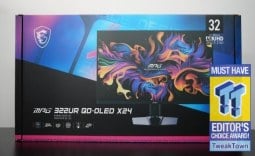 MSI MPG 322UR QD-OLED X24 Review: A Brighter, Tougher 4K 240Hz QD-OLED for $1099
 UGREEN NASync DXP4800 GT Review: powerful 4-bay NAS with AMD Ryzen and dual 10GbE ports
 Dell XPS 14 (2026) Laptop Review - Premium Quality, Impressive Performance
 Ocypus Sigma F36 BK ARGB Cooling Fan Review: high airflow and unified design in one frame
 PCCooler CPS RZ820 Display Review: a flagship-level CPU air cooler with an LCD screen
 UGREEN FineTrack Mini 2 Air Tracker Tag Review - Long battery life, lesser performance
 Speed Racer (2008) 4K Ultra HD Blu-ray Review: a stunning remaster of the cult classic
 MOAIPLAY ORA PRO G1 850W ATX 3.1 PSU Review: high efficiency and 10-year warranty for $119.99
 Navman MiVue Smart True 4K Surround Dashcam Review - Seeing In All Directions At Once
 Hisense U7SG 4K TV: Modern Entertainment for the New Age
 6 underrated Microsoft Word features worth using to boost your productivity
 Level Up Your PC Gaming with these Fantastic ASUS Prime Day Deals on GPUs, Motherboards, and More
 GIGABYTE Wants to Kickstart Your New Gaming PC or Upgrade with These Limited-Time Deals
 7 Windows settings to change right after installation for better privacy, security, and performance
 I stopped Windows 11 notifications from interrupting me with Do Not Disturb, Focus, and a priority list
 7 ways to transfer data from Android to Windows PC quickly and easily
 I read the Windows Backup app screen carefully, and it does not back up what most people think
 Low Sound Volume on Windows 11? How to fix audio issues and restore normal volume
 8 Critical Warning Signs You Should Never Ignore in Windows 11