


Motherboards
Get the latest motherboard news, including AMD and Intel boards, new chipset launches, BIOS/UEFI updates, and upcoming motherboard releases.
Stay Updated
Follow TweakTown for breaking tech news, reviews, and daily updates.


As an Amazon Associate, we earn from qualifying purchases. TweakTown may also earn commissions from other affiliate partners at no extra cost to you.
GIGABYTE unveils a pair of B850 motherboards with backside connectors, bringing cable-stealth to a lower price point
Motherboards with backside connectors are gathering momentum in the market, but with a few exceptions, they've tended to be expensive models. GIGABYTE is bucking that trend. It's readying two Micro-ATX B850M Stealth motherboards that will fall within the budgets of users wanting a super-clean build.

There are two versions of the B850M AORUS Stealth, differing only in the choice of white and black colors. They feature refreshingly simple aesthetics, mostly free of highlights, flourishes and branding, which is exactly what the cleanest of builds need.
GIGABYTE says the boards are the first mATX boards with back side connectors, which opens up a new market for smaller form factor builds. It will be compatible with a wide range of cases from nearly all of the major manufacturers. Though it may be a while before dedicated mATX cases with backside connector support are widely available.
ASRock marks 10 years of its Taichi brand with special Z890 and X870E 10th anniversary editions
Computex 2026 is officially underway, and we visited the ASRock booth to see what the company has been cooking up. Sadly it's still too early to see even a tease of next-generation motherboards, but there's still plenty to like with current boards. To celebrate 10 years of its Taichi brand, ASRock showed off a pair of 10th Anniversary Edition boards. One features the Intel Z890 chipset, while the other features AMD's X870E chipset.

Both boards feature a subtle design aesthetic, free of excessive branding and lines that run every which way. Many Taichis appeal for exactly this reason.
The X870E Taichi 10th Anniversary appears to be based on the currently available X870E Taichi. It features a 24+2+1 phase VRM with 110A stages, an ESS Sabre DAC, 10G LAN, USB4 and all the goodies you'd expect from a high-end board. It includes a 64MB BIOS ROM, so it is all set to support upcoming Zen 6 processors.
ASUS celebrates 20 years of ROG with a special 20th Anniversary Edition X870E motherboard - and a trip down memory lane
ASUS came out swinging at Computex 2026, showcasing a range of new and exciting products. That might not extend to motherboards as we await new chipsets and CPUs, but that didn't stop ASUS from showcasing the stunning ROG Crosshair X870E Edition 20.

This board is not to be confused with the ROG Crosshair 2006 that we covered previously, though that is also a glorious-looking board we were happy to see in person. The X870E Edition 20 is a new beast.
The board comes with a flagship-tier spec, including support for a massive nine M.2 SSDs! On the back, we spotted dual 10G LAN ports, loads of fast USB ports and a 24+2+2 phase VRM with enormous heatsinks. Along with the 6.67-inch AMOLED display atop the ROG Ryujin, it's safe to say that essentially every conceivable feature possible on a 2026 consumer motherboard is present.
MSI unveils a pair of special high-end motherboards to celebrate its 40th anniversary
MSI was founded in 1986, and to celebrate its 40th anniversary, the company has unveiled an amazing-looking motherboard ahead of Computex 2026. The MSI MEG Z890 Ace Draco Epic features a beautiful theme that MSI says is inspired by Draco, a constellation in the northern sky. Of course it's also inspired by MSI's Lucky dragon mascot.

The Draco Epic is based on the existing MEG Z890 Ace. We were told the specifications of the two boards are identical, with only the design being different. Not that it needs much - if anything in the way of upgrades, as the Z890 Ace is a top end board, with only the ultra-expensive halo tier MEG Z890 Godlike sitting above it in MSI's lineup.
The Z890 Ace Draco Epic is loaded with features, including a powerful 24+2+1+1 phase VRM with massive heatsinks, dual Thunderbolt 4, 10G LAN, five M.2 slots and 60W USB PD, among many other features.
MSI's upcoming MPG B850 Carbon Max WiFi is about as high-end as any B850 motherboard can get
MSI is off to the Computex 2026 races, and it's unveiled a flagship B850 motherboard that puts some X870 models to shame. The MPG B850 Carbon Max WiFi packs high-end features and a fantastic aesthetic into a board that looks every bit as premium as its X870E stablemates.

The B850 Carbon Max includes three ARGB zones, and has headers for more, making it a board that's well suited for tailored builds. It's got a beefy 14+2+1 VRM and large heatsinks, making it a good option for overclockers. It also includes an OC engine, or in other words an external clock generator for fine-tuning overclocks.
Other features include 5G LAN, 320MHz full-speed WiFi 7, four M.2 slots and 20Gbps USB. USB4 is absent, but I'm only aware of 2 other B850 boards that include that. It's also got plenty of DIY-friendly features and a 64MB BIOS ROM, so it's well positioned to accept Zen 6 processors in the future. MSI probably knows a thing or two about them already!
GIGABYTE teases what may be the most extreme consumer motherboard ever
At its pre-Computex 2026 press conference, GIGABYTE unveiled what may be the most over-the-top consumer motherboard ever created. The GIGABYTE X870E AORUS Infinity Next features a space-age design - and we mean that literally.

The board features a 3D-printed honeycomb heatsink structure made of what GIGABYTE refers to as 'rocket thruster-grade thermal materials'. When I talked to a GIGABYTE representative, I was told that this alone costs well into four figures, and it takes two days to print. For each board! It goes without saying that this will be a very limited edition board that will cost thousands of dollars. The primary M.2 heatsink is no less impressive, featuring more cooling area than some boards' VRM heatsinks.
That's not the only over-the-top feature. It's got a cutting-edge VRM that combines multiple stages into one. To use the common phase count parlance. It has a 64-phase VRM capable of delivering over 5000 Amperes of current. Crazy stuff!
Continue reading: GIGABYTE teases what may be the most extreme consumer motherboard ever (full post)
GIGABYTE's halo tier X870E AORUS Xtreme X3D AI TOP motherboard wins a Computex Best Choice award
Computex 2026 is just days away. It's become tradition for the organizers to give out a series of Best Choice awards highlighting some of the more attention-grabbing products at the show. The GIGABYTE X870E AORUS Xtreme X3D AI TOP motherboard received an award in the Computer and System category. It's a gloriously ridiculous flagship board that I want, but at over $1,000, I can't afford.

The X870E AORUS Xtreme X3D AI TOP is an updated version of the AORUS Xtreme AI TOP that includes GIGABYTE's X3D Turbo Mode 2.0. It's an AI-powered enhancement that's designed to extract more performance from AMD's Ryzen X3D processors. That aside, the board has almost every conceivable feature you can get on a consumer motherboard.
It features an LCD screen, dual 10G LAN, loads of fast USB ports with 65W PD support, a strong VRM and five M.2 slots. The AORUS Xtreme X3D AI TOP packs in a huge amount of cooling capacity. Finned VRM heatsinks, a memory cooler, a large M.2 cooler and a rear backplate combine into what promises to be a board with one of the best cooling assemblies ever seen. I won't say for sure until I have tested it, but that's surely a safe assumption. I'll ask GIGABYTE for a review sample. This is one board I'll be happy to play with.
COLORFUL launches new compact iGame B850M ULTRA Series motherboards
COLORFUL has announced a pair of new compact Micro-ATX motherboards for AMD Ryzen platforms with the new iGame B850M ULTRA-S and the iGame B850M ULTRA-OC. Design-wise, these new boards feature a similar look and feel as the stylish COLORFUL iGame GeForce RTX 5070 Ultra OC we recently reviewed, and they're built for gamers, creators, and enthusiasts putting together a compact rig.

Both boards support the latest AMD Ryzen AM5 platform, which means they feature Wi-Fi 7 and Bluetooth 5.4 connectivity and support for overclocked AMD EXPO DDR5 memory. They're also ready for the latest Ryzen 9000 Series desktop processors, including the popular Ryzen 7 9800X3D. In fact, despite the flagship iGame B850M ULTRA-OC's compact size, it ships with a 10+2+1 phase 60A DrMOS power design that's more than ready to handle the latest Ryzen 9 9950X3D flagship CPU.
As for the iGame B850M ULTRA-S, this is a motherboard built for mainstream gaming and running professional workloads. It sports a robust 14+2+1-phase 80A DrMOS power design with dual 8-pin CPU power connectors and four reinforced DDR5 DIMM slots that support DDR5-8400 speeds, with a total capacity of 256GB. Storage-wise, it's also packed, with three M.2 slots, including two PCIe 5.0 x4 slots, ready for the latest Gen5 SSDs.
Continue reading: COLORFUL launches new compact iGame B850M ULTRA Series motherboards (full post)
ASUS celebrates 20 years of ROG with the Crosshair 2006, a retro-styled X870E motherboard
ASUS has announced the ROG Crosshair 2006 motherboard, paying homage to the first ROG motherboard, released 20 years ago. It is described as a cousin to the Crosshair X870E Dark Hero, but with a design language that transports gamers back to the early 2000s, featuring a retro copper aesthetic and classic ROG blue elements.

While the design offers a nostalgic look, that's about the only retro thing here. The rest of the motherboard offers the most advanced gaming technology available in 2026, including features that 2006 gamers could only dream of. That includes a 2-inch OLED screen on the main M.2 slot that can display CPU clock speeds, temperatures, custom GIFs, animations, and more.
Another prominent design theme is the blue-and-white color scheme for memory, PCIe, and SATA connectors. In addition, rather than hiding components under plastic shrouds, the board boldly exposes its copper heatsinks alongside much of the PCB and its components.
ASUS teases new 20th anniversary ROG Crosshair motherboard
ASUS Republic of Gamers (ROG) is celebrating its 20th anniversary this year, and we're expecting some big announcements from the gaming-focused brand at Computex 2026. And thanks to a little teaser over on the official ASUS ROG Instagram page, we've got our first look at what one of these might be, a reimagining of one of the very first premium motherboards released under the ROG banner.

In fact, this is a motherboard we reviewed back in 2006, the ASUS Crosshair Republic of Gamers, and noted it was "extremely powerful and stacked with impressive features" for gamers and overclockers. Although the look and feel of PC gaming hardware has definitely evolved over the subsequent 20 years, this first ROG Crosshair motherboard helped set the brand's trend of releasing stylish and powerful gear, thanks to its bright copper heatsink that covered the VRM, northbridge, and southbridge.
And it's the copper heatsink and classic ROG logo in the teaser that point to it being a reimagining of the classic motherboard. One of the more notable design touches on the original was its inclusion of a pretty basic LCD for monitoring, with this teaser hinting that the 20th-anniversary edition ROG Crosshair motherboard will ship with a full-color display featuring an animated version of the classic ROG logo.
Continue reading: ASUS teases new 20th anniversary ROG Crosshair motherboard (full post)
MaxSun's two new MoDT motherboards bring Intel's 10-core Raptor Lake to the desktop despite the Core 200H branding
Chinese board manufacturer MaxSun has expanded its lineup with two new Mobile on Desktop (MoDT) motherboards: the MS-MoDT 230H D4 WIFI and the MS-MoDT 205H D4 WIFI. The company is promoting both boards globally as compact MoDT options for SFF systems, workstations, edge systems, and value-focused desktop builds.

For those unfamiliar, MoDT motherboards are specialized desktop-form-factor boards with laptop-grade processors soldered directly onto them. They typically come in Micro-ATX or Mini-ITX sizes and offer a more affordable alternative to traditional socketed CPU and motherboard combinations, though you do have to sacrifice the ability to upgrade your processor later.
Coming back to Maxsun's boards, the Core 200H branding is more misleading than MaxSun probably intended. These are not Arrow Lake boards. Intel lists the Core 7 230H and Core 5 205H under Raptor Lake, meaning these are previous-generation mobile chips that Intel quietly rebadged as part of the Core 200H line during Q1 2026.
AMD's X970E chipset rumored to reuse the PROM21 chipset, but with native support for CUDIMM
Taiwanese hardware manufacturer Biostar recently teased next-gen AMD motherboards planned to be showcased at Computex 2026. The PR announcement has since been quietly edited, with the "next-generation" wording removed, which likely means AMD wasn't ready to go public yet or Biostar got a little too excited. The company didn't name a specific chipset, but the wording points to a new AM5 board lineup, something in the vein of an X970E, though nothing is confirmed.

That's not the most interesting part of this story, though. A new leak from MEGAsizeGPU suggests AMD's next-generation AM5 platform may reuse the same Promontory 21 chipset found in all existing AM5 motherboards. The difference from the current 800-series and previous 600-series boards could come in the form of add-on features, new BIOS-level software capabilities, and significantly overhauled memory support.
That memory support could include full compatibility with both CUDIMM and CAMM modules, rather than only partial compatibility added via recent AGESA updates. CUDIMM, or Clocked Unbuffered DIMM, incorporates an onboard clock driver that helps support higher memory speeds. CAMM, or Compression Attached Memory Module, is a thinner memory form factor designed primarily for laptops and high-volume OEM desktop systems, using a compression connector to save space.
Biostar teases next-gen AMD motherboards to Computex 2026, and it could be our first look at the Zen 6 platform
Taiwanese motherboard manufacturer Biostar has announced plans to showcase "next-generation AMD" motherboards at Computex 2026. This makes Biostar one of the first vendors to hint that next-gen AMD platforms will appear at the show, potentially tied to Ryzen CPUs based on the upcoming Zen 6 architecture. The lineup is expected to include a new Valkyrie gaming model for enthusiasts, as well as more mainstream designs to suit a range of users.

Biostar doesn't explicitly say what it means by "next-generation," but the context isn't hard to read. AMD is working on Zen 6-powered Ryzen desktop CPUs codenamed Olympic Range, which are rumored to scale up to 24 cores. Along with the usual generational uplift in performance and efficiency, platform updates are also expected. We have already seen early groundwork, with board makers rolling out features such as EXPO 1.2 support for CUDIMM and low-latency DDR5, as well as upcoming enhancements like CPPC Highest Frequency.
Given these factors, it seems plausible that early designs of next-gen AM5 motherboards could appear at Computex, not just from Biostar but other board partners as well. However, another possibility is that Biostar is branding a refreshed 800-series lineup as next-generation. AMD has already advanced its AM5 platform to the X870E and X870 generation, so if Biostar is pointing to a genuinely new chipset rather than another X870 refresh, that would suggest X970 or a related 900-series platform for next-gen Ryzen processors.
COLORFUL's new BATTLE-AX motherboards offer both DDR5 and DDR4 options for Intel gamers
COLORFUL has introduced a new pair of compact M-ATX motherboards as part of its refreshed BATTLE-AX motherboard series. Built for performance, versatility, and affordability, these Intel Core Ultra 200S Series and 12th, 13th, and 14th-Gen Core-compatible boards offer gamers the option to choose between next-gen DDR5 performance and speed and cost-effective DDR4 memory.

As the naming suggests, the new BATTLE-AX B860M-PLUS S WIFI7 and B760M-PLUS S WIFI7 motherboards also support the latest Wi-Fi 7 wireless networking standard alongside Bluetooth 5.4 support. The BATTLE-AX B860M-PLUS S WIFI7 is built for the latest Intel Core Ultra 200S Series, and its dual-channel DDR5 memory supports speeds of up to 8,800 MT/s, with single-DIMM configurations also available for those looking to save a bit of money.
With a robust 10+1+1+1-phase 60A DrMOS power design, the compact board also includes three M.2 SSD slots with an integrated heatsink and tool-free installation, one of which is PCIe 5.0 x4-ready. The rear I/O is also packed with expansion options, with it including six USB Type-A ports and two USB Type-C ports.
Coreboot port almost complete for MSI Pro B850-P AM5 motherboard, current implementation almost boots into Linux
The developers behind coreboot have provided an update on their progress developing a port of the open-source BIOS to a consumer AM5 motherboard, the MSI Pro B850-P. Phoronix reports that 3mdeb, the company behind coreboot, has successfully ported several important blocks required to support AMD (Phoenix) Ryzen 8000 APUs, featuring MPIO, SMU, NBIO, FCH SD, FCH ACPI, and RcMgr. The company also addressed the missing USB initialization code that was causing USB failures to occur on the board previously.

All these changes have made the open-source port almost fully functional, with the team stating that its open-source BIOS implementation now almost makes it to the Linux login screen. In addition to the aforementioned USB fixes, the team also resolved a system hang caused by a bug in the PCIe enumeration process. The main issue that remains is a problem (or problems) surrounding the promontory B850 chipset, causing hard faults to occur.
Development of this port has taken a couple of months so far, split into multiple parts. Part one involved enabling bootblock and romstage and mapping all of the USB, SATA, and PCIe ports on the motherboard. Part 2 involved adding USB and PCIe devicetree descriptors and integrating Ryzen 8000 series openSIL code into the port.
ROG forum member confirms X670 and B650 series motherboards will be getting EXPO 1.2 in the future
AMD launched EXPO 1.2 a few days ago, but support only included X870E and X870 motherboards, making it unclear if the technology was going to trickle its way down to older motherboard chipsets. As reported by Uniko's Hardware on X, we now have confirmation that EXPO 1.2 will be making its way to older 600-series AM5 motherboards featuring X670 and B650 chipsets.

The news comes from Safedisk on the ROG forums, who responded to a forum member asking whether EXPO 1.2 support would trickle down to X670 series motherboards. Safedisk affirmed the response, noting that X670 and B650 would be getting support, but warned that development was going to "need time". Safedisk's confirmation also suggests that EXPO 1.2 support will be coming to B850 and B850E motherboards as well. There is no reason for AMD to restrict EXPO 1.2 support from B850/B850E motherboards when B650/B650E motherboards are receiving the update.
EXPO 1.2 is the latest iteration of AMD's Extended Profiles for Overclocking standard, and is AMD's counterpart to Intel's XMP standard. Version 1.2 of EXPO adds support for mix and matching DDR5 DIMMs with different capacities, CUDIMM, Ultra Low Latency mode, and support for three Chinese-based DDR5 memory manufacturers. However, there is a caveat with CUDIMM support; the memory controllers in AMD's outgoing AM5 CPUs don't support the CKE chip in CUDIMMs and thus can only run these modules in a compatibility mode that bypasses the CKE chip. Full support will be coming with Zen 6. For more details, check out our previous content on EXPO 1.2.
Intel's Z970 chipset could replace most B860 motherboards for Nova Lake, leaker claims
Intel recently promised to bring overclocking to lower-priced chips, but whether platform support would extend to mainstream motherboards remained a mystery. A new rumor now suggests that the upcoming Nova Lake S desktop platform will see Z970 replace both the high-end Z890 and the mainstream B860, while a new B960 chipset will serve as the true budget option.

Leaker Jaykihn0 provided this information in response to a since-deleted X post highlighting that Z970 will cover most of the market currently served by B860. In response to a VideoCardz comment, he suggested readers view the Z970 as the successor to most B860 boards, noting a shift in positioning rather than a major change in features.
By 'most of the market,' Jaykhin likely means the premium end of the B860 range, specifically models priced between $200 and $250. If Z970 boards land in the $199 to $249 range, buyers in that segment will gain CPU overclocking support, a feature the budget-oriented B960 will lack.
ASUS announces its first TUF Gaming Mini-ITX motherboard for compact PCs
ASUS has officially announced the new TUF Gaming B850I WiFi NEO motherboard for Mini-ITX systems, and it's the first TUF Gaming board in this compact form factor. Measuring 17 by 17 centimeters, this AMD AM5 motherboard uses the more affordable B850 chipset for Ryzen 7000, 8000, and 9000 processors.

As it falls under the TUF Gaming banner, it sports a premium 10-layer PCB, which ASUS says is made from "server-grade" materials that extend to the reinforced PCIe slot. It also features an 8+2+1-phase VRM rated at 80A for a balanced power solution with real-time voltage control, and dual DDR5 memory slots supporting speeds of up to 9,600+ MT/s.
As a compact board, it includes only a single PCIe 5.0 x16 slot for a single GPU, along with two M.2 PCIe 5.0 SSD slots underneath a heatsink. As spotted on the spec sheet, the PCIe 5.0 x16 slot runs at full speed when paired with Ryzen 9000 and 7000 CPUs, but drops to PCIe 4.0 when paired with a Ryzen 8000 Series processor.
GIGABYTE's Z890 AORUS TACHYON DUO X ICE motherboard supports DDR5-10400 out of the box
GIGABYTE has a new motherboard for the overclockers out there, and it's the stunning Z890 AORUS TACHYON DUO X ICE. As the name suggests, this is a white, grey, and silver-colored board that delivers performance to match its style. The big thing here is that it has two DDR5 slots supporting the new CQDIMM memory technology unveiled at CES 2026.

A CQDIMM (Clocked Quad-rank Unbuffered Dual In-line Memory Module) provides 256 GB of memory capacity via two 128GB modules, while delivering high speeds and enhanced stability. For the Z890 AORUS TACHYON DUO X ICE, which features GIGABYTE's new D5 Duo X technology, overclockers and enthusiasts will be able to reach memory speeds of DDR5-10400 or 10,400 MT/s thanks to the CQDIMM upgrade and premium design that includes PCB optimizations and custom BIOS tuning.
This motherboard is a follow-up to the original Z890 AORUS TACHYON ICE for the Intel Core Ultra 200S Series, but this time the dual memory slots and the CPU socket are laid out horizontally as opposed to vertically. It features an 18+1+2 Digital VRM Design, an 8-layer PCB, and premium capacitors.
NVIDIA's N1 SoC pictured on an engineering board with 128GB of memory for local AI
Just weeks before the rumored Computex unveiling, NVIDIA's N1 SoC (System-on-Chip) for WoA (Windows on Arm) devices has surfaced, suggesting the silicon is in its final validation phase. Hardware enthusiast RubyRapids on X found an engineering board on Goofish that appears to be a mobile reference design showcasing the N1 in all its glory.

After a year of delays and pivots, most notably the decision to prioritize the GB10-based DGX Spark at Computex last year, it seems NVIDIA's N1 family is finally nearing launch. With Jensen Huang himself teasing an upcoming SoC collaboration with MediaTek just months ago, all signs now point to a massive N1 and N1X finally being on track for a debut at Computex 2026.
Targeting the high-end WoA market, the N1 series utilizes a "superchip" design that combines a MediaTek-designed CPU with NVIDIA's Blackwell GPU architecture. The chip leverages the same GB10 silicon as the DGX Spark. It features 20 Arm cores-both Cortex-X925 (Performance) and Cortex-A725 (Efficiency)-split into two clusters, each with 16MB of L3 cache. On the graphics side, there is a Blackwell-based integrated GPU with up to 6,144 CUDA cores, comparable to the RTX 5070. The wide 256-bit memory interface supports 128GB of LPDDR5X-8533 memory, delivering about 273 GB/s of bandwidth, similar to Apple's M5 Pro and AMD's Strix Halo.
 Europe's new Switch 2 model could drive up production costs even higher
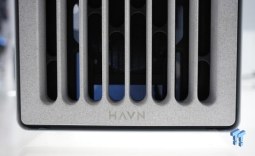 HAVN's BF 360 Flow case puts vertical GPU cooling front and center
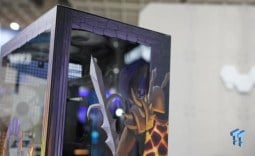 This Old School RuneScape-themed PC case and keyboard almost brought a tear to my eye
 Biwin's new PCIe Gen5 SSD delivers next-gen speeds to everyone while only drawing 4.5W
 Biwin's new BL130 Mini SSD unlocks a new era of storage for gaming handhelds
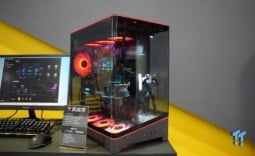 GAMDIAS unveils gorgeous curved glass PC case with a built-in action figure display stage
 MSI's STRIKE ALLOY TMR is a premium keyboard that comes with an intuitive smart display
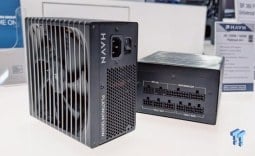 HAVN brings its focus on performance and quality to its first XR power supplies
 After emptying a stranger's wallet, NVIDIA's Jensen Huang found the owner and paid him back with profit
 HAVN's HS 360 case is lighter, smaller, and enhances airflow to keep your GPU nice and cool
 Asetek Forte S-Series Racing Simulator Bundle Review
 Razer Pro Type Ergo Wireless Split Ergonomic Keyboard Review - Built for Comfort and Support
 ASUS ROG Strix Morph 96 Wireless Gaming Keyboard Review - Great Performance, More Affordable
 SAPPHIRE Radeon RX 9070 GRE PULSE OC Review - A New 1440p Challenger Has Arrived
 NZXT H6 RGB+ Compact Dual-Chamber Chassis Review
 ASRock Radeon RX 9070 GRE Steel Legend Review - The RDNA 4 Mid-Range Reshuffle
 ASRock Z890 Taichi Aqua Motherboard Review - Flagship features without the flagship price
 GIGABYTE Z890I AORUS Ultra Motherboard Review - Mini-ITX with surprisingly good thermals
 Seagate FireCuda X1070 4TB SSD Review - A New Mainstream Contender
 Lian Li HYDROSHIFT II 360P OLED Curved Liquid CPU Cooler Review
 Phison E37T SSD Controller Exclusive Preview - The Fastest DRAMless SSD Platform Yet
 USB Ports Not Working in Windows 11? Try These Fixes
 ASUS WiFi Routers and Networking Solutions Deliver Long-term Security and Reliability with No Additional Cost
 Second Monitor Not Detected in Windows 11? Try These Fixes
 Turn Your Old Smartphone Into a Dedicated Webcam for Your Windows PC
 The Send To menu is the right-click feature on Windows 11 that nobody bothers to customize
 Windows 11 will not let you pin a folder to the taskbar, but a 30-second workaround does
 ASUS ProArt Displays Unlock Creativity with Professional Monitors for Everyone
 What Happens If You Don't Activate Windows 11? 5 Downsides Explained
 Fast Internet on Your Phone but Slow on Your PC? Try These Fixes