




Our Verdict
Pros
- Thermal performance
- Cost and availability
- Aesthetics
- Easy-to-use hardware and no software
- ARGB
Cons
- Noise level
- Somewhat unknown manufacturer at this stage
Should you buy it?
AvoidConsiderShortlistBuyIntroduction, Specifications, and Pricing
So far as we can tell, with limited information thus far, is that SAMA is into providing style and performance at an exceptionally low cost, and in today's excessive price hikes, it is just what the market needs. With thirty various solutions in both air and liquid cooling, SAMA has everything from the budget single tower designs all the way up to the likes of the A60 coolers we saw not that long ago. In AIO land, they have a couple of more ordinary options, others with slick light up fan corners, all the way up to what we have today, which appears to be their current flagship product.
Keeping things affordable, most users would assume it is some random POS with little to stand on in the vast assortment of options, but what you are about to see will twist and distort your sense of pricing across the entire segment. If what we have in hand to show off today is even slightly impressive, it stands what we know of AIO CPU coolers on its ear. Considering that some AIOs can cost up to and beyond the $400 mark, depending on the feature set, seeing an AIO of this size and performance capabilities makes us wonder what the rest of the market is doing, other than lessening our pile of funds.
For those on a serious budget, or those with the desire to save funds in certain areas to better options for CPUs, memory, or the like, SAMA is someone to seriously consider. While they are newer to the scene, every manufacturer starts somewhere, but few are as impressive out of the gate as the L70 CPU cooler. It may not include an IPS screen that is all the rage now, but what it does offer comes in the form of unique styling, performance we never saw coming, and all at a cost that may have you wondering what the rest of the market has been doing to us all this time.
| Item | Details |
|---|---|
| Model | L70 360WH |
| MSRP | $79.99 |
| Socket | Intel: LGA 1851 / 1700 / 1200 / 115x AMD: AM5 / AM4 |
| Color | White |
| Tube | 400mm |
| Radiator Dimensions | 397 x 120 x 27mm |
| Radiator Material | Aluminum |
| Pump Dimensions | 73 x 73 x 66mmm |
| Pump Speed | 2000 - 3000 ±10% RPM |
| Pump Connector | 4-pin PWM |
| Voltage | 12VDC |
| Current | 0.42A |
| Bearing Type | Ceramic |
| Included Fans | 3 PCS |
| Fan Dimension | 120 x 120 x 28mm |
| Bearing Type | Hydraulic |
| Speed | 800 - 2200±10% RPM |
| Airflow | 72.3 CFM |
| Air Pressure | 2.85 mmH2O |
| Noise | ?28 dB(A) |
| Voltage | 12VDC |
| Current | 0.35A |
| Connector | 4-Pin PWM |
| Fan LED Type | ARGB |
| Connector | 5V 3-Pin |
| Current | 0.2A |
| Pump LED Type | ARGB |
| Connector | 5V 3-Pin |
| Current | 0.3A |
| Warranty | 3 Years |
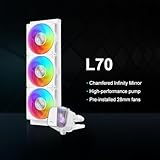
The L70 comes with a 360mm radiator to cool the CPU (and there is a smaller 240mm version, too), and you will find it in white, as we have, or in black, should that be a better match. As most CPU coolers do these days, mounting hardware covers AM4 and AM5, along with all mainstream sockets since and including LGA115X. The chart shows that we have 400mm of tubing, sleeved to match the color options of the L70, and then immediately switch gears to the radiator. The Radiator is made of aluminum, painted to match either theme, but also sports the SAMA name and logo on both sides. All told, without the fans, it measures 27mm thick, 397mm long, and 120mm wide.
The head unit is also white, with a large portion of clear plastic housing some stylish ARGB presentation. It is 73mm square and stands 66mm tall, and inside is a ceramic bearing floating the impeller. SAMA shows the pump to run in a range of 2000 to 3000 RPM via a 4-pin PWM connection. The fans of choice come installed on the radiator, and while 120mm in size, they are 28mm thick. These three fans spin on a hydraulic bearing, turning up to 2200 RPM. At maximum speed, you will see 73 CFRM with 2.85 mmH2O with less than 28 dB(A) of noise. These fans do include ARGB hubs and are PWM controlled,
The last couple of points are impressive. Not only do we get a relatively unknown manufacturer delivering an AIO with a three-year warranty instead of just one, but there is also the cost. While many of this caliber and feature set would set the average AIO onto the market at $100 - $150 to obtain, SAMA offers its top-tier solution at just $79.99. You didn't read that wrong, and no, we did not forget the one in front of that number. For just $80, you will likely be as impressed as we are with the way the market is shifting in our favor.
Our Latest CPU Liquid Coolers Review Coverage
| Today | 7 days ago | 30 days ago | ||
|---|---|---|---|---|
 | $51.99 USD | $54.99 USD | ||
| $64.99 CAD | $64.99 CAD | ||
| $51.99 USD | $54.99 USD | ||
| $51.99 USD | $54.99 USD | ||
 | Check Price | Check Price | ||
* Prices last scanned 5/15/2026 at 2:41 pm CDT - prices may be inaccurate. As an Amazon Associate, we earn from qualifying purchases. We earn affiliate commission from any Newegg or PCCG sales. | ||||

Packaging

Helping to stay affordable, SAMA uses plain cardboard to box their AIO, and even the information is kept to a minimum. On the front, we get a blue angled line which highlights the L70 name while drawing the eye to the full color image of the cooler inside. Other than that, we get the SAMA name and logo, and a notation of its 360mm size.

The line we saw on the front carries over the top of the box, where we see the SAMA name and logo once again.

The smaller end of the box loses the blue line in favor of the SAMA name and logo; that's it.

The back of the box holds the information users seek. At the top, it tells us to visit the site for more information, but the specifications shown below are quite specific and cover everything we discussed earlier.

At the other small end of the box, it is a match of the other end of the box, except that this time we get a QR code to take us online for the installation guide, but there is also one in the box.

Inside the box, you will find recycled cardboard used for the inner packaging, along with a dense layer of foam on top to help protect everything inside. The parts are individually sleeved in plastic to protect the paint, while the hardware is set between them.
SAMA L70

At first glance, the half-white and half-clear cover on the head unit may not seem so impressive, but the SAMA logo and the unique style get much better with the ARGB fired up.

Mounting hardware comes attached to the head unit and works with both camps, and the right side is used to connect the swivel fittings and sleeved tubes to the head unit, as well as being the location of the 4-pin and ARGB cables exit.

The base plate is made of copper; it is convex, higher in the center, and while it appears to be cast, there are very fine circular machine marks left in the plate, adding surface area for better thermal results.

As we leave the head unit, we run into a pair of clips. These not only hug the tubes to keep them even once installed, but they also have a central channel to run wires from the head unit, should that work out with your layout.

Sixteen inches from the end of the swivel fittings, we run into the radiator and its pre-installed fans.

In the middle of both sides of the radiator, you will find the SAMA name and logo, making it easy for friends or internet buddies to see.

While there isn't a sticker with any information at this end as we typically see, we can see the fittings match at both ends of the tubing, and while the fans state they are 28mm thick, it is due to the isolation pads and not the frame of said fans.

Stepping back, we see the metallic hub covers with the SAMA name and logo, but more importantly, a single 4-pin fan connector and a single ARGB connector to deal with. Also, looking between the blades, we see that SAMA uses a high FPI radiator with their high-powered fans.
Accessories and Documentation

The hardware that comes with the L70 is simple to use and informative. The Intel set of brackets on the left has multiple mounting holes and arrows that should point to the CPU. The Intel backplate has SAMA logos, but also shows the ends move to whichever socket type is needed. The much shorter AMD brackets have a single mount point as well as arrows.

Universal bits come in the form of these four knurled nuts with Phillips heads to secure them, along with a set of standoffs that work for all installations as well.

The last bits you will find in the box to help with your endeavor to install the L70 are the SAMA Freeze and a set of twelve radiator mounting screws.

The user guide is more about the illustrations than the verbiage, but even with very few words, what is presented will get you through the installation without issue. While working with Intel first, then AMD, it ends with a wiring diagram and a code to show you an installation video, should you need more help. The warranty covers all the basics and tells you what can be claimed and who to contact within the three years it is covered.
Installation and Finished Product

Following the guide, it says remove the factory clips from the AMD motherboard, and replace them and their screws with the standoffs, the short brackets top and bottom, and use the knurled nuts to secure it all to the board.

To get here, we applied paste and installed the head unit, and then dealt with the radiator installation. After that, you have two 4-pin PWM fan connections to make, and you can daisy-chain the ARGB connectors to a single header.

With power applied, the lighting kicks in, and it really drives the style factor up a notch or two. While only half the design is visible, the cubic shapes and the ring around the outer edge bring the SAMA L70 head unit into the realm of what users expect.

Stepping back to view the L70 in its entirety, we like what we see. We are huge fans of high-contrast builds, and this is a big check in that box. The ARGB in the fans may be sourced only in the hubs, but the translucent blades do a great job of picking it up and spreading it across the fans. All things considered, we have a hard time knocking the SAMA L70 feature set and presentation.
Test System Setup, Thermal Tests, and Noise Results
Chad's CPU Cooler Test System Specifications
| Item | Details |
|---|---|
| Motherboard | ASUS ROG STRIX X870E-E Gaming Wi-Fi (Buy at Amazon) |
| CPU | AMD Ryzen 9 9900X (Buy at Amazon) |
| RAM | Patriot Viper Elite 5 32GB @ 7000MT/s (Buy at Amazon) |
| GPU | GIGABYTE GeForce RTX 4070Ti Super Windforce OC 16G (Buy at Amazon) |
| SSD | Patriot Viper 2TB VP4300 PCIe m.2 Gen4 x4 (Buy at Amazon) |
| Case | be quiet! Light Base 900 DX (Buy at Amazon) |
| Case Fans | be quiet! Light Wings White 140mm PWM High-Speed ARGB (Buy at Amazon) |
| Power Supply | be quiet! Dark Power Pro 12 1500W (Buy at Amazon) |
| OS | Microsoft Windows 11 Home 64-bit (Buy at Amazon) |
| Software | AIDA64 Engineer 7.60.7300, and CPU-z 2.14.0 x64 |
To see our testing methodology and to find out what goes into making our charts, please refer to our 2025 CPU Cooler Testing and Methodology article for more information.
Thermal Results

With our fans turning at 1138 RPM at idle, and the pump spinning at 3103 RPM, the SAMA L70 delivers the 41.2°C idle temperature we see in the chart. While it may seem like we were off to a sour note to start, things do improve.

Under loaded conditions, the SAMA L70 took no prisoners on its rise to the top. Almost a full degree more efficient than the Ocypus solution that used to top the chart is a discernible difference, and we are more than surprised that SAMA pulled off this 60.9°C average temperature.

Proving it is not a fluke, even when it comes down to the maximum temperature reached under stress, the 63°C result topping this chart shows that the L70 can control whatever you put under it.
CPU Speed

We did expect a higher CPU average speed, as low as the thermals were, but even at 5252 MHz, it is still at the upper end of results, and well above many others in the chart.
VRM Thermal Results

Second, the land of AIOs is not a bad place to land when it comes to VRM temperatures, and 62°C is a few degrees warmer than we saw in the HyperFlow, but sits well with the rest of the results from other manufacturers of liquid-cooled solutions.
Fan Speed and Noise Levels

Idle fan speed being 1138 RPM showed us that SAMA was not too pressed to push the fans to get results, and at 1436 RPM under load, noise can become a concern, although this is the give, so that SAMA could take top honors in the thermal results.

The only real issue with the SAMA L70 is the noise. Many have gotten used to the move towards silence, losing performance. SAMA said do what needs to be done, which is why they end up at 52 dB.
Final Thoughts
SAMA has proved a few things here. First and foremost, you do not need the oldest name in the game to deliver chart-topping performance. You can have style and great thermal performance without breaking the bank. You also may need to pay more attention to these newer companies, as they must find a way to break into the market and win your affection. SAMA and their L70 do all these things, give you options of black or while coolers, and on top of everything else, shakes up the way we as users should be looking at the AIO market.
We could complain about the lack of a screen, we could argue that there are options with less noise, or we could be like the masses and just never give SAMA a try, but with what we have seen today, we have to at least get you to pay attention to SAMA as they are turning the market on its head, as we as consumers weigh the options. Yes, you could have fancier ARGB implementation, you can get a fancy IPS screen, but you can also fork out as much as the motherboard or the CPU as you do for those AIOs.
For the cost, we expected nothing like what the SAMA L70 is capable of. Not its styling, not the cool tricks of hidden fan wiring and wire clips to route head unit cables. We did not expect it to top our thermal charts; however, we had a sense it would be old school loud to get things done. One might assume that this is a basic, no-frills unit with all the corners cut to save a penny, but that is not the case at all.
At only $79.99, you too can enjoy top-tier performance, a boost in CPU speed, and something stylish delivering a flood of ARGB into the chassis. That's right, for the cost of any average CPU air cooler, you can have a 360mm radiator-backed AIO that just makes sense. With a decent feature set and an unbeatable price, if anything, products like these will ease the market in our favor, but why wait when you can enjoy all the benefits of an AIO with a third of the cost of its direct competition? As for us, we will be finding a use for our SAMA L70, as it's just too good to bin or pass along.


 PCCooler CPS RZ620M X CPU Cooler Review
 Cooler Master Cosmos Alpha Full-Tower Chassis Review
 Corsair 3200D Mid-Tower Chassis Review
 Antec FLUX Pro Noctua Edition Full-Tower Chassis Review
 Montech Sky 3 Mid-Tower Chassis Review
 Forza Horizon 6 has made at least $20 million from advanced access on Steam alone
 Thermal Grizzly is now selling delidded Intel Core Ultra 7 270K Plus CPUs for enthusiasts
 Rumor: Next-gen Xbox may get disc-to-digital option to convert physical media into virtual games
 Sony expects PlayStation to break new profit records even while it invests in PS6
 PlayStation to deliver 32% returns this year, Sony predicts
 New Xbox cloud and Elite controllers leaked as Microsoft teases cloud-native games, tests free streaming
 Subnautica 2 is a mega hit with 2 million sales in 12 hours
 ASUS enters the memory business and launches its first 'ROG' DDR5 RAM modules
 Popular Chinese retailer JD briefly listed banned RTX 5090 and RTX PRO 6000 Blackwell GPUs
 Security researcher finds zero-day exploit that defeats Windows 11 BitLocker, calls it an insane 'backdoor' discovery
 Memblaze PBlaze 7 7A40 Ocean 61.44TB Enterprise SSD Review - Oceans of QLC at 3.3 million IOPS
 MOZA SGP Sequential Sim Racing Shifter Review
 COLORFUL iGame GeForce RTX 5070 Ultra OC Review - When Style and Performance Meet
 GIGABYTE Z890 AORUS Elite WiFi7 Plus Motherboard Review - Right in the sweet spot
 PNY GeForce RTX 5080 Slim OC Review - A Compact 4K Powerhouse
 HP OmniBook 7 (Panther Lake) 16" Laptop Review
 ASUS ROG Strix X870E-E Gaming WiFi7 NEO - A Crosshair by any other name
 Thrustmaster T598 Direct Axial Drive Force Feedback Racing Wheel Bundle Review
 Bluetooth Toggle Missing in Windows? Try These Fixes
 GPU Overclocking Basics in Windows 11: Safe Performance Gains Without the Guesswork
 GIGABYTE's new Ultimate OLED Gaming Monitor Bundle includes Xbox Game Pass
 I automated 5 annoying Windows maintenance tasks, and my PC basically runs itself
 How to Fix Windows 11 Black Screen on Boot or After Login
 The first 8 settings I disable on every fresh Windows 11 install in 2026
 Is Your Ethernet Performance Slower Than Wi-Fi? Here's How to Fix It
 MSI's Project Zero Delivers a Stunning Cable-Free Look to More Gamers
 How to Fix "We Couldn't Find a Fingerprint Sensor Compatible With Windows Hello" in Windows 11
 Why Is My Mouse Moving on Its Own? Here's How to Fix It