




Our Verdict
Pros
- Highest sequential read
- Best-in-class mixed workloads
- Superior consistency
Cons
- None
Should you buy it?
AvoidConsiderShortlistBuyIntroduction and Drive Details
KIOXIA currently makes what we are inclined to believe is the best-performing flash in the industry. Based on our vast experience with BiCS 8 flash in the consumer space, where it has proven to deliver more performance than anything else, and by a decent margin, we expect that the same likely holds true in the enterprise realm as well.
KIOXIA's newest mainstream PCIe Gen5 Data Center Series SSD, the CD9P, at capacities of 6.4TB and up, comes arrayed with its cutting-edge BiCS 8 NAND, so we are definitely excited to see what this mainstream enterprise SSD can deliver, and how it compares with others in its class that are arrayed with Micron, Hynix, and YMTC flash.
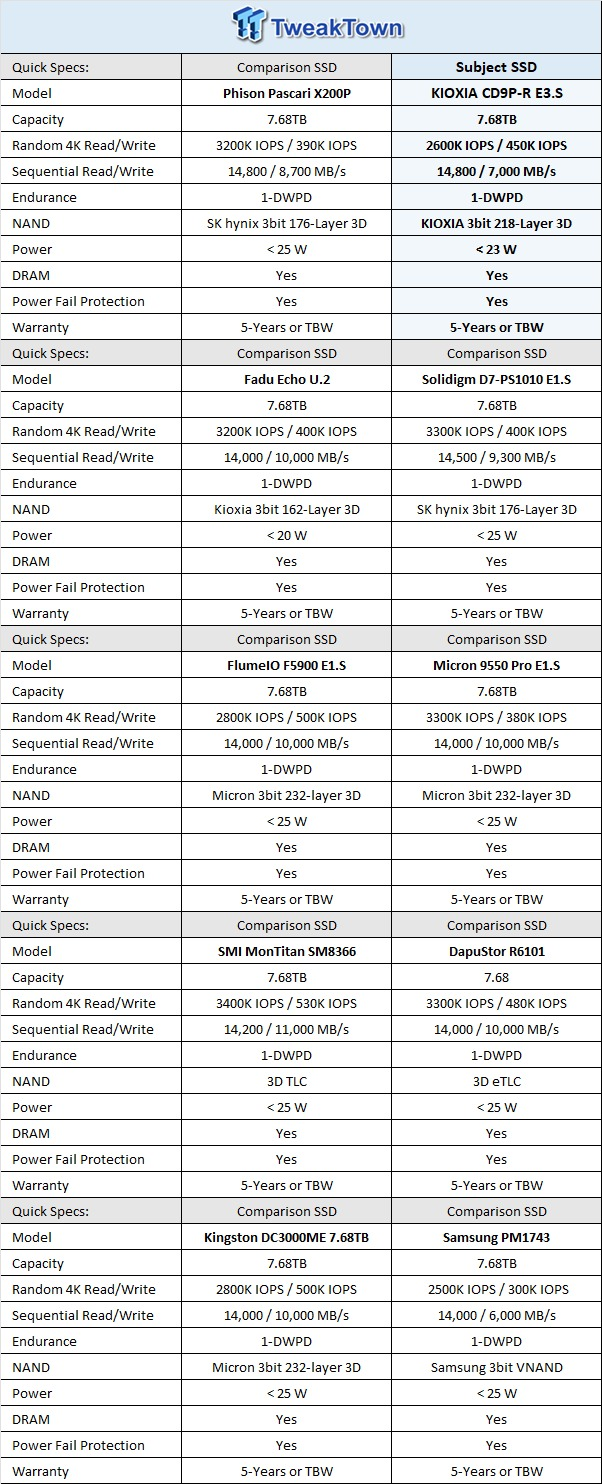
As stated, the CD9P is a mainstream offering and as such, isn't sporting crazy high specs of 3.4 million IOPS and 11 GB/s sequential write capabilities. The CD9P is rated at a much lower 2.6 million IOPS and 7 GB/s sequential write capabilities. However, when it comes to real-world performance or performance where it matters most, the highest specs don't always deliver the best performance curve, where it typically matters most, being sequential read throughput and mixed workloads at low queue depths.
As stated previously, we are of the opinion that BiCS 8 flash is likely the highest performing of all the various flash currently in circulation, and because the CD9P at capacities of 6.4TB and higher comes arrayed with it, we are inclined to believe that our 7.68TB test subject will more than hold its own even against others sporting flashier factory specs.
The subject of today's review is KIOXIA's CD9P-R read-intensive 1-DWPD SSD in the E3.S form factor. The E3 form factor is becoming increasingly popular in the datacenter because it is more efficient than conventional U.2 in terms of footprint/density and has a more modern interface designed specifically for NVMe SSDs. However, cooling can be a bit more challenging at a slim 7.5mm thickness, so we always like to take a quick look at temperatures when testing E3 or E1 SSDs.
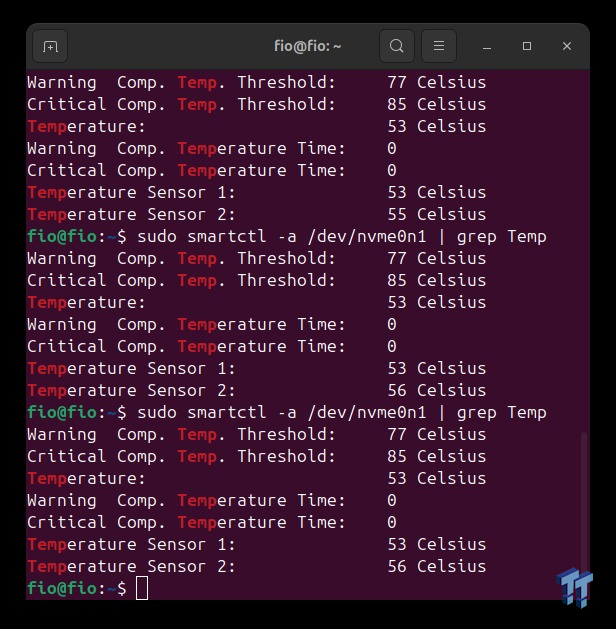
Pictured above are temperatures taken nearing the end of 2-loops of 128K sequential write preconditioning, where we feel temperatures are likely their highest. Typically, we could see temperatures near 70°C here with standard air cooling, but not with our test subject. Here we find our CD9P-R 7.68TB running at a relatively cool 53°C with conventional air cooling. Outstanding.
Specs/Comparison Products
Our Latest SSD Review Coverage
- Memblaze PBlaze 7 7A40 Ocean 61.44TB Enterprise SSD Review - Oceans of QLC at 3.3 million IOPS
- DapuStor Roealsen6 R6060 E1.L 245.76TB SSD Review - Massive Capacity with Fast Retrieval
- Phison Pascari X200P 7.68TB Enterprise SSD Review - Sequential Read Champion
- Micron 9550 Pro E1.S 15mm 7.68TB SSD Review - G8 Flash for Read-Intensive AI Storage Compute
- DapuStor Roealsen6 R6301 12.8TB AIC SSD Review - The Ultimate Workstation SSD
| Item | Details |
|---|---|
| Model | KIOXIA CD9P-R 7.68TB |
| MSRP | NA |
| Model Number | KCD91PJE30T7 |
| Interface | PCIe Gen5 x4 |
| Form Factor | E3.S |
| Sequential BW | Up to 14,800 MB/s |
| Random IOPS | Up to 2600K IOPS |
| Warranty | 5-Years Limited |
KIOXIA CD9P-R 7.68TB E3.S 7.68TB PCIe Gen5 x4 SSD


The drive we have in hand is a 1-DWPD design, E3.S form factor, 7.68TB in capacity, KIOXIA BiCS 8 TLC arrayed, and 16-channel controlled. This configuration is rated for up to 2.6 million IOPS and up to 14.8 GB/s sequential throughput. KIOXIA's CD9P Series SSDs are compatible with major operating systems such as RHEL, SLES, CentOS, Ubuntu, Windows Server, and VMware ESXi.
Test System Specs & Enterprise Testing Methodology
Enterprise SSD Test System
| Item | Details |
|---|---|
| Motherboard | ASUS Pro WS W790E-SAGE SE (Buy at Amazon) |
| CPU | Intel Xeon w7-2495X (Buy at Amazon) |
| GPU | GIGABYTE GeForce GTX 1650 (Buy at Amazon) |
| Cooler | Alphacool Eissturm Hurricane Copper 45 (Buy at Amazon) |
| RAM | Micron DDR5-4800 RDIMM (Buy at Amazon) |
| Power Supply | be quiet! Dark Power Pro 12 1200W (Buy at Amazon) |
| Case | PrimoChill's Praxis Wetbench (Buy at Amazon) |
| OS | Ubuntu 24.04.1 LTS |
A special thank you goes to Allyn Malventano, without whose help we wouldn't be where we are with our Linux-based Enterprise SSD testing platform.
Testing Methodology
TweakTown strictly adheres to industry-accepted Enterprise Solid State Storage testing procedures. Each test we perform repeats the same sequence of the following steps:
- Secure Erase SSD
- Write the entire capacity of SSD 2x (2 loops) with 128KB sequential write data, seamlessly transition to the next step (sequential testing skips step 3)
- Precondition SSD by filling the drive twice with random 4K, 8K, or IU of SSD writes
- Run test-specific workload with a 30-second ramp up for 5 minutes at each measured Queue Depth, and record average result

| Today | 7 days ago | 30 days ago | ||
|---|---|---|---|---|
 | $229.99 USD | $229.99 USD | ||
| $292.66 CAD | $271.94 CAD | ||
| - | - | ||
| $229.99 USD | $229.99 USD | ||
 | Check Price | Check Price | ||
* Prices last scanned 5/16/2026 at 2:24 am CDT - prices may be inaccurate. As an Amazon Associate, we earn from qualifying purchases. We earn affiliate commission from any Newegg or PCCG sales. | ||||

Benchmarks - Sequential
128K Sequential Write/Read

We precondition the drive with 100 percent sequential 128K writes at QD256 using 1-thread for 2-drive fills, receiving performance data every second. We plot this data to observe the test subject's descent into steady-state and to verify that steady-state is in effect as we seamlessly transition into testing at queue depth. A steady-state is achieved after a 1-drive fill. Average steady-state 128K sequential write performance at QD256 is approximately 7,200 MB/s.


KIOXIA specs its CD9P Series SSDs as capable of delivering up to 7,000 MB/s 128K sequential write throughput. We are getting up to 7,200 MB/s, so pretty much exactly as advertised. We love what we see at QD1, where our test subject is delivering the second most throughput of any of the SSDs appearing on this chart and doing so where it arguably matters most. Excellent.


Here, the drive is factory spec'd for up to 14,800 MB/s 128K sequential read throughput. We are hitting up to a lab record-breaking 15,044 MB/s, so it is better than advertised and at a place where throughput matters most for read-intensive applications. Not only is it the fastest of its kind that we've ever encountered, but just look at that superior performance curve where it is dominating at the mid-range and then edging out the rest from there on up. Impressive.
Benchmarks - Random
4K Random Write/Read

We precondition the drive using 100 percent random 4K writes at QD256 for 2-drive fills, receiving performance data every second. We plot this data to observe the test subject's descent into steady-state and to verify that steady-state is in effect as we seamlessly transition into testing at queue depth. A steady-state is achieved after a 1-drive fill. Average steady-state 4K random write performance at QD256 is approximately 500K IOPS.


Our 7.68TB model is rated at up to 450K 4K random write IOPS. We are getting up to 518K, so we are doing a bit better than advertised. Again, we will point out that at QD1, where programming performance matters most, our test subject exceeds expectations massively by delivering another lab record, and this time an all-time lab record for any flash-based SSD we've ever tested. Wow.


Factory spec here is up to 2,600K IOPS. We are getting 2,758K with our configuration. At first glance, it appears as if our test subject is underperforming compared with the up to 3.5 million IOPS-capable competition. However, at practical queue depths of up to 64, where performance matters most, our test subject is right in there with the best we've ever seen. Excellent.
4K 7030


The performance curve at queue depths of up to 64 here is the best we've ever seen coming from a non-compressed 1-DWPD SSD. This is what dominant real-world performance looks like. Amazing.
4K 5050


As we add more programming into the mix, our test subject again responds better than we've ever seen coming from a 1-DWPD SSD. Again, delivering the best performance curve we've ever encountered for its type, and yet another lab record for the most IOPS of its kind. Impressive.
8K Random Write/Read

We precondition the drive using 100 percent random 8K writes at QD256 for 2-drive fills, receiving performance data every second. We plot this data to observe the test subject's descent into steady-state and to verify that steady-state is in effect as we seamlessly transition into testing at queue depth. A steady-state is achieved after a 1-drive fill. Average steady-state 8K random write performance at QD256 is approximately 270K IOPS.


We expect 8K random to track pretty much the same as 4K random here, just at a lower IOPS rate because it's moving twice the amount of data. Our test subject delivers better than half of what we saw at 4K. And again, as we saw at 4K, its QD1 performance is among the best we've ever encountered.


Nice performance curve here, especially at queue depths of up to 64.
8K 7030


8K 7030 is representative of a common database workload. We note especially compelling low queue depth performance where our test subject delivers better than any competing conventional 1-DWPD SSD we've tested to date. As we see it, because database workloads typically execute at low queue depths, this is yet again the best performance curve for any SSD of its type that we've come across. Incredible.
8K 5050


And finishing strong, our test subject delivers the best performance curve here that we've ever encountered from a 1-DWPD SSD. Outstanding.
Final Thoughts
Overall, we are blown away by what we would have to characterize as this wolf in sheep's clothing SSD. Looking at its factory up to specs, one would assume that this mainstream Data Center SSD could easily be bested on the performance front by much of its competition. However, this SSD has what those SSDs don't have, and that's BiCS 8 flash.
Again, it's all about the flash as we see it, and our assertion that BiCS 8 is likely the most powerful of its kind currently in circulation is certainly bolstered by what KIOXIA's CD9P-R 7.68TB delivered today. At every point where we feel performance matters most, this lower spec'd SSD absolutely dominated everything in its class.

In our opinion, it's the best of its kind ever made. Editor's Choice.


 Memblaze PBlaze 7 7A40 Ocean 61.44TB Enterprise SSD Review - Oceans of QLC at 3.3 million IOPS
 DapuStor Roealsen6 R6060 E1.L 245.76TB SSD Review - Massive Capacity with Fast Retrieval
 Phison Pascari X200P 7.68TB Enterprise SSD Review - Sequential Read Champion
 Micron 9550 Pro E1.S 15mm 7.68TB SSD Review - G8 Flash for Read-Intensive AI Storage Compute
 DapuStor Roealsen6 R6301 12.8TB AIC SSD Review - The Ultimate Workstation SSD
 Thermal Grizzly is now selling delidded Intel Core Ultra 7 270K Plus CPUs for enthusiasts
 Rumor: Next-gen Xbox may get disc-to-digital option to convert physical media into virtual games
 Sony expects PlayStation to break new profit records even while it invests in PS6
 PlayStation to deliver 32% returns next year, Sony predicts
 New Xbox cloud and Elite controllers leaked as Microsoft teases cloud-native games, tests free streaming
 Subnautica 2 is a mega hit with 2 million sales in 12 hours
 ASUS enters the memory business and launches its first 'ROG' DDR5 RAM modules
 Popular Chinese retailer JD briefly listed banned RTX 5090 and RTX PRO 6000 Blackwell GPUs
 Security researcher finds zero-day exploit that defeats Windows 11 BitLocker, calls it an insane 'backdoor' discovery
 AMD's FSR 4 coming to RDNA 2 could give the Xbox Series X a PS5 Pro-like upgrade
 PCCooler CPS RZ620M X CPU Cooler Review
 MOZA SGP Sequential Sim Racing Shifter Review
 COLORFUL iGame GeForce RTX 5070 Ultra OC Review - When Style and Performance Meet
 GIGABYTE Z890 AORUS Elite WiFi7 Plus Motherboard Review - Right in the sweet spot
 PNY GeForce RTX 5080 Slim OC Review - A Compact 4K Powerhouse
 HP OmniBook 7 (Panther Lake) 16" Laptop Review
 ASUS ROG Strix X870E-E Gaming WiFi7 NEO - A Crosshair by any other name
 Cooler Master Cosmos Alpha Full-Tower Chassis Review
 Thrustmaster T598 Direct Axial Drive Force Feedback Racing Wheel Bundle Review
 Bluetooth Toggle Missing in Windows? Try These Fixes
 GPU Overclocking Basics in Windows 11: Safe Performance Gains Without the Guesswork
 GIGABYTE's new Ultimate OLED Gaming Monitor Bundle includes Xbox Game Pass
 I automated 5 annoying Windows maintenance tasks, and my PC basically runs itself
 How to Fix Windows 11 Black Screen on Boot or After Login
 The first 8 settings I disable on every fresh Windows 11 install in 2026
 Is Your Ethernet Performance Slower Than Wi-Fi? Here's How to Fix It
 MSI's Project Zero Delivers a Stunning Cable-Free Look to More Gamers
 How to Fix "We Couldn't Find a Fingerprint Sensor Compatible With Windows Hello" in Windows 11
 Why Is My Mouse Moving on Its Own? Here's How to Fix It