



Our Verdict
Pros
- OC Engine
- 64MB BIOS
- 320MHz WiFi 7
- Three PCIe x16 (physical) slots
- Subtle good looks
Cons
- Expensive launch price
- No USB4
- Few differences over the Tomahawk MAX
- Primary M.2 heatsink isn't the greatest
Should you buy it?
AvoidConsiderShortlistBuyIntroduction, Specifications, and Pricing
AMD's AM5 socket keeps on keeping on, and 800 series motherboards are not going anywhere anytime soon. MSI's MAG B850 Tomahawk Max WiFi II is not the second B850 Tomahawk as the name might suggest. It's actually the third, following the original B850 Tomahawk and the B850 Tomahawk Max.
MSI's Tomahawk motherboards usually come to the attention of budget-conscious buyers. They appeal with solid feature sets, good cooling, and subtle designs. I generalize them as no-frills, no-fuss options for users who want a reliable board that's a clear step up in quality and features over entry-level models, while priced below mid-range models. Let's see if the B850 Tomahawk Max II follows suit.
The B850 Tomahawk Max II supports AMD AM5 Ryzen 7000, 8000, and 9000 series CPUs. As it is a new release, it supports CPUs including the Ryzen 9 9850X3D out of the box. It supports up to 256GB of memory and features a 14+2+1-phase VRM with attractive heatsinks. It comes with 5G LAN, 320MHz WiFi 7, a 64MB BIOS ROM, and it incorporates EZ-DIY features. Also present is an external clock generator for CPU base clock overclocking. Sadly, though, USB4 is absent.
| Item | Details |
|---|---|
| Model | MSI MAG B850 Tomahawk Max WiFi II |
| CPU Socket | AM5 |
| Chipset | AMD B850 |
| CPU Support | AMD 7000, 8000 & 9000 series |
| Memory | 4 x DDR5 DIMM slots, up to 256GB, up to 8400+ MT/s (OC) |
| Expansion slots | 1x PCIe 5.0 x16, 1x PCIe 4.0 x16 (x4), 1x PCIe 3.0 x16 (x1) |
| Storage | 4x M.2, 4x SATA |
| Ethernet | Realtek RTL8126VB 5GbE |
| Wireless & Bluetooth | MediaTek MT7927 WiFi 7, Bluetooth 5.4 |
| USB | Up to 1x 20Gbps, 5x 10Gbps, 5x 5Gbps, 8x USB 2.0 |
| Audio | Realtek ALC4080 |
| Form Factor | ATX |
| MSRP | $269 |
The MSI MAG B850 Tomahawk Max WiFi II is available for $269, which, in isolation, is a good price; however, a check at Newegg shows the B850 Tomahawk Max selling for $209, which is very appealing. The original Max misses out on the 64MB BIOS ROM and the OC engine. Of those two features, the former may prove critical in the years ahead, while the latter will appeal only to a small number of buyers. In time, the Max II will surely decrease in price, though.
| Today | 7 days ago | 30 days ago | ||
|---|---|---|---|---|
 | $269.99 USD | - | ||
 | - | - | ||
| $379.99 CAD | - | ||
| - | - | ||
| $269.99 USD | - | ||
| $269.99 USD | - | ||
 | $395 | - | ||
* Prices last scanned 5/16/2026 at 3:03 am CDT - prices may be inaccurate. As an Amazon Associate, we earn from qualifying purchases. We earn affiliate commission from any Newegg or PCCG sales. | ||||
Packaging, Accessories, and Overview

The B850 Tomahawk Max WiFi II comes in a compact box. The only real feature highlighted is the 64MB BIOS. It's also AI-ready. Aren't they all?

In contrast to the front of the box, the rear shows a comprehensive rundown of the board's key features and specifications, along with a view of the rear I/O.
Our Latest Socket AM5 Review Coverage
- ASUS ROG Strix X870E-E Gaming WiFi7 NEO - A Crosshair by any other name
- Sapphire Pure X870A WiFi 7 Motherboard Review - Premium looks at a bargain price
- GIGABYTE X870E Aero X3D Wood Motherboard Review - A touch of wood adds a touch of class
- MSI MPG X870I Edge Ti Evo WiFi Motherboard Review - Packed and stacked Mini-ITX
- ASRock X870E Taichi OCF Motherboard Review - A memory OC monster

The board comes with an atypical set of accessories consisting of a Wi-Fi antenna, two SATA cables, a quick start guide, stickers, M.2 accessories, and regulatory notices. The final cable, called the EZConn cable, connects to the JAF_2 header on the motherboard. It combines a system fan, a 5V ARGB header, and a front USB 2.0 header into one, making it a good way to eliminate some case cable spaghetti.
Motherboard Overview

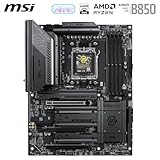
MSI has tweaked the Max II's design. It's removed some of the polarizing green and yellow highlights, opting instead for a more neutral, mostly black theme. I think MSI tends to go a bit overboard with its dragon logo, which is missing from this board. Overall, I think it is the best-looking of the 800-series Tomahawks, though personally, I was not averse to the green splashes.

The board itself doesn't have any built-in RGB, but there are three ARGB headers and a 12V RGB header for lighting strips. There are eight 4-pin fan headers, which is an impressive number.
In the old days, overclockers were highly appreciative of budget overclocking boards. Immediately adjacent to the bottom PCIe slot are a pair of jumpers that directly adjust the CPU's base clock in real time. You'll need to supply your own 2-pin switches, though. I'm a little surprised MSI didn't opt for two small buttons instead of jumpers. This feature will be useful for owners of 7000 series X3D chips, which are multiplier-locked. You can also control the base clock via the BIOS.
The front USB complement comprises a single Type-C 20Gbps port, four Type-A 5Gbps ports, and four USB 2.0 ports. The 20Gbps port is the fastest available on the board.

Four DIMM slots support DDR5-8400+ speeds with a capacity of up to 256GB. Interestingly, MSI states that Ryzen 9000 series processors support this speed. Often, they are rated lower than 8000 series chips. As has been the case since AMD introduced the AM5 platform, it recommends memory in the DDR5-6000 to DDR5-6400 range. Running faster memory means halving the memory controller speed, which adds latency.

The B850 Tomahawk Max II features a 14+2+1 (VCore, SoC, Misc) phase VRM with 80A stages. It's enough to handle a Ryzen 9 9950X with PBO enabled, and it will surely handle the upcoming 9950X3D2 with its higher TDP.
The brushed-metal heatsinks have ample surface area and deep grooves. The metal plate atop the main heatsink looks classy, too. A 10-minute Cinebench R24 loop yielded a peak VRM temperature of 57 degrees Celsius, which is lower than some much more expensive boards.

The board has four M.2 slots mounted on the PCB, two of which support PCIe 5.0 x4 drives. The other two support PCIe 4.0. The M2_3 slot only supports x2 speeds. It shares bandwidth with the bottom-most PCIe 4.0 (PCI_E3) slot. You can switch this slot to x4 in the BIOS, but this will disable the M2_3 slot. I think this is a fair compromise for a B850 board. You can still run a full set of four M.2 SSDs and three expansion cards simultaneously, which is impressive. There are four SATA ports too.
The B850 Tomahawk Max II features three physical PCIe x16 slots. The primary slot supports PCIe 5.0 x16 electrically and is reinforced for heavy graphics cards. The second slot supports PCIe 3.0 x1 electrically. Three x16 slots ensure compatibility, but when one of them supports just PCIe 3.0 x1, an x16 physical slot seems a bit superfluous.

The primary M.2 heatsink features a quick-release mechanism, but it lacks the surface area of some competing boards. The other heatsinks are attached with screws.

The rear I/O of the board is well equipped, though some may find the lack of high-speed 20Gbps or 40Gbps USB ports a concern. The USB complement consists of four USB 2.0 ports, one 5Gbps port, and five 10Gbps ports. I don't mind seeing USB 2.0 ports, as they are useful for devices like keyboards, mice, and printers that don't need lots of bandwidth.
A BIOS flashback button is a near-essential feature for AM5 boards, especially given that B850 boards are certain to support another generation of CPUs, and perhaps one more after that. A CMOS clear button is placed next to it.
The board's networking capabilities are strong, consisting of a Realtek RTL8126VB 5G controller and a MediaTek MT7927 WiFi 7 controller, which supports 320MHz connections and up to 5.8Gbps of bandwidth.
Next are the audio ports, which consist of 3.5mm line-in and line-out ports and S/PDIF. A Realtek ALC4080 codec drives these.
UEFI, Software and Test System
UEFI


I am impressed by the modern UEFI design and layout MSI introduced with its 800 series boards. It combines the simplicity of old-school BIOS layouts with a fresh design that's easy on the eye, with attractive fonts and contrast. The hardware monitoring page, in particular, is very well designed. The fan controls are highly customizable.
The EZ Mode page has almost every setting a user will need. All set-and-forget features, such as XMP, PBO, boot priority, and fan controls, can be accessed from this page.
MSI calls its motherboard software the MSI Center. I really like the way it lets you download modules instead of a whole suite of bloat you may never use. The Mystic Light RGB control and hardware monitoring apps are likely downloads, but there's also a bunch of AI-assisted (of course) modules for tasks such as diagnostics and performance, audio, and networking.
Test System
- CPU: AMD Ryzen 9 9950X - Buy from Amazon
- GPU: MSI GeForce RTX 4070 Ti Super Ventus 3X - Buy from Amazon
- RAM: G.Skill Trident Z Neo RGB 2x16GB DDR5-6000 CL30 - Buy from Amazon
- Cooler: Cooler Master MasterLiquid PL360 Flux - Buy from Amazon
- OS Storage: Teamgroup T-Force Z540 2TB - Buy from Amazon
- Power Supply: Super Flower Leadex Titanium 850W - Buy from Amazon
- OS: Microsoft Windows 11 Pro - Buy from Amazon
Benchmarks - Rendering and Encoding
Cinebench 2024
Cinebench 2024 is a reliable, widely used benchmark that measures both single and multi-threaded performance. Note that all our benchmark testing used the latest available Windows updates.

The B850 Tomahawk Max WiFi II scored 2,308 in the nT test and 141 in the 1T test. That's enough for it to take top spot in our list of tested boards.
Blender
A rendering application like Blender is just one of many reasons a user might consider a high-core-count CPU, such as the Ryzen 9 9950X. We use the Whitelands demo file and record how long it takes to render the image.

A result of 430 seconds is one of the faster results, even if a couple of seconds over a seven-minute test isn't all that significant.
Handbrake
Handbrake is a simple-to-use video encoding and transcoding application. Here, we convert a 4K movie trailer to 1080p. The results below show the average FPS, where higher values indicate the task will take less time to complete.

A 160.0 FPS result is decent and just fractionally behind the fastest boards.
Benchmarks - File Compression and Memory Latency
7Zip
7Zip is a commonly used free file compression and decompression app. It's very sensitive to changes in memory speed and latency, and scales with the number of CPU threads.

A score of 228.49 BIPS is a mid-pack result for the Tomahawk.
AIDA64 Memory Latency
Memory latency has been an area where Intel traditionally held an advantage. Chiplet architectures inevitably add some latency compared to monolithic chips. The real-world benefits aren't that important, though.

This result is a bit of an outlier. It's the slowest we've seen to date, though in percentage terms it's nothing to worry about.
Benchmarks - PCMark and 3DMark
PCMark 10 Productivity
We'd love to use our PCs solely for leisure, but some of us have to work too! The PCMark 10 productivity test performs a series of tests using office productivity applications.

The differences between the boards are not large in this test.
3DMark Storage
UL's newest 3DMark SSD Gaming Test is the most comprehensive SSD gaming test ever devised. It is superior to testing against games themselves because, as a trace, it is much more consistent than variations that will occur between runs of the actual game.

A score of 4,099 is decent, but this test can be influenced by random background SSD accesses, and a half-second here or there in loading times will not be noticed.
3DMark Time Spy Extreme
Time Spy Extreme has lost favor as a graphics benchmark to Speed Way and Steel Nomad, but its CPU test is still a good measure of multi-core performance.

The differences between the boards are minor, with only a few hundred points separating them when measured by CPU score.
Benchmarks - Gaming
Cyberpunk 2077
Cyberpunk 2077 is brutal on graphics cards, but when things like ray tracing are removed, it becomes more sensitive to CPU and memory performance differences.

It's no surprise that the motherboard makes little difference in graphically limited scenarios.
Horizon Zero Dawn
When using the 'favor performance' preset, Horizon Zero Dawn can achieve high frame rates with powerful graphics cards.

The differences here are negligible in percentage terms.
Metro Exodus Enhanced Edition
Metro Exodus received an update that added improved DLSS support, enhanced ray tracing features, and variable rate shading. Still, with a powerful graphics card, it is affected by CPU and memory performance at 1080p, though less so with a card like the RTX 4070 Ti Super.

All the tested motherboards perform essentially identically, but the good minimum FPS result is enough to place the MSI at the top of the list by a whisker.
VRM and SSD Temperatures
These tests are performed to show off the differences between each motherboard's cooling assemblies. In the case of VRM testing, each board is subjected to a 20-minute Cinebench loop, while the SSD test records the peak temperature recorded during the lengthy 3DMark Storage test.

A peak temperature of 57 degrees is a good result for the B850 Tomahawk Max WiFi II. The board's large heatsinks and deep grooves help keep temperatures well in check.

This result is certainly a result of the low surface area of the B850 Tomahawk Max II's primary M.2 heatsink. The 3DMark Storage test is not overly demanding, so you'll need good case airflow if you plan to frequently move multi-terabyte files around. An underside thermal pad would also be beneficial for double-sided drives. MSI can do better here.
Final Thoughts
MSI's Tomahawk motherboards usually rate well on these pages. They tend to offer rich feature sets with no frills at an affordable price. The MAG B850 Tomahawk Max WiFi II is another solid Tomahawk entry.
The biggest problem for the Max II is the Max I. It's available for $209 compared to the $269 launch price for the Max II. However, it doesn't include an external clock generator or the 64MB BIOS ROM. If you care nothing for fine-tuning your overclock, or overclocking a multiplier-locked Ryzen 7000 X3D chip, then its benefits don't apply. The 64MB ROM is also nice to have, but it remains to be seen if that will end up a must-have, at least until Zen 6 CPUs arrive. In time, the Max II's price will surely drop, but $60 at the time of writing is a good chunk of money, especially in a tough economy beset with sky-high memory prices.
Price aside, the Max II is the preferred option. As a refresh board, there are certainly undocumented circuitry tweaks here and there. It's got a VRM that will happily run any Ryzen chip, including the 9950X3D2. You get 5G LAN, and 320MHz WiFi 7, four M.2 slots, and three PCIe slots, all of which can be run simultaneously with manageable compromises. There are plenty of USB ports, though there's just the one 20Gbps front port. Still, we're talking about a B850 board here. You'll need to spend more if you want the features of an X870 board, such as USB4.

I've long been a fan of MSI's UEFI. It is easy to navigate, and it's easy on the eye. MSI's software has also come a long way. You can choose the modules you want to install without unnecessary bloat.
As long as you have adequate airflow to keep M.2 temperatures under control, the MSI MAG Tomahawk Max WiFi II is a capable motherboard with strong expansion and connectivity potential. It'll happily host high-end components - including Zen 6 CPUs. It's a particularly notable overclocking option that hearkens back to the days of affordable overclocking boards. It doesn't quite earn an award at this point in time due to Max I discounts, but assuming its price drops after stock levels stabilize, it will surely take its place among the best B850 motherboards.


 GIGABYTE Z890 AORUS Elite WiFi7 Plus Motherboard Review - Right in the sweet spot
 ASUS ROG Strix X870E-E Gaming WiFi7 NEO - A Crosshair by any other name
 Sapphire Pure X870A WiFi 7 Motherboard Review - Premium looks at a bargain price
 GIGABYTE X870E Aero X3D Wood Motherboard Review - A touch of wood adds a touch of class
 MSI MPG X870I Edge Ti Evo WiFi Motherboard Review - Packed and stacked Mini-ITX
 Forza Horizon 6 has made at least $20 million from advanced access on Steam alone
 Thermal Grizzly is now selling delidded Intel Core Ultra 7 270K Plus CPUs for enthusiasts
 Rumor: Next-gen Xbox may get disc-to-digital option to convert physical media into virtual games
 Sony expects PlayStation to break new profit records even while it invests in PS6
 PlayStation to deliver 32% returns this year, Sony predicts
 New Xbox cloud and Elite controllers leaked as Microsoft teases cloud-native games, tests free streaming
 Subnautica 2 is a mega hit with 2 million sales in 12 hours
 ASUS enters the memory business and launches its first 'ROG' DDR5 RAM modules
 Popular Chinese retailer JD briefly listed banned RTX 5090 and RTX PRO 6000 Blackwell GPUs
 Security researcher finds zero-day exploit that defeats Windows 11 BitLocker, calls it an insane 'backdoor' discovery
 PCCooler CPS RZ620M X CPU Cooler Review
 Memblaze PBlaze 7 7A40 Ocean 61.44TB Enterprise SSD Review - Oceans of QLC at 3.3 million IOPS
 MOZA SGP Sequential Sim Racing Shifter Review
 COLORFUL iGame GeForce RTX 5070 Ultra OC Review - When Style and Performance Meet
 PNY GeForce RTX 5080 Slim OC Review - A Compact 4K Powerhouse
 HP OmniBook 7 (Panther Lake) 16" Laptop Review
 Cooler Master Cosmos Alpha Full-Tower Chassis Review
 Thrustmaster T598 Direct Axial Drive Force Feedback Racing Wheel Bundle Review
 Bluetooth Toggle Missing in Windows? Try These Fixes
 GPU Overclocking Basics in Windows 11: Safe Performance Gains Without the Guesswork
 GIGABYTE's new Ultimate OLED Gaming Monitor Bundle includes Xbox Game Pass
 I automated 5 annoying Windows maintenance tasks, and my PC basically runs itself
 How to Fix Windows 11 Black Screen on Boot or After Login
 The first 8 settings I disable on every fresh Windows 11 install in 2026
 Is Your Ethernet Performance Slower Than Wi-Fi? Here's How to Fix It
 MSI's Project Zero Delivers a Stunning Cable-Free Look to More Gamers
 How to Fix "We Couldn't Find a Fingerprint Sensor Compatible With Windows Hello" in Windows 11
 Why Is My Mouse Moving on Its Own? Here's How to Fix It